FAQ schema marks up your question-and-answer content in a format that search engines and AI systems can parse. In the past, this schema could trigger expandable FAQ dropdowns directly in Google search results - your listing would show collapsible questions beneath the title, taking more visual space than competitors.
- FAQ schema structures your Q&A content in a format search engines and AI systems can read.
- Google has limited traditional FAQ rich result displays - most e-commerce stores will not see dropdown questions in SERP.
- Structured FAQ data still helps search engines understand what questions your page answers.
- AI search tools like ChatGPT, Gemini, and Perplexity can extract and reference structured FAQ content.
- Risify outputs valid FAQPage schema automatically when you assign FAQs to products or collections.
What FAQ Schema Does
FAQ schema - formally called FAQPage structured data - marks up question-and-answer pairs in a format that machines can parse. Instead of seeing unstructured text on a page, search engines and AI systems see explicit signals: this is a question, this is its answer.
How It Works
You add JSON-LD markup to your page that identifies each Q&A pair. A page with three FAQs has three Question objects, each containing an Answer object. The structure is standardized, so any system that reads schema can interpret it the same way.
What This Enables
Structured FAQ data changes how LLMs read your content:
- Search engines can index your page as containing specific Q&A content rather than general text.
- AI systems can extract individual answers to individual questions.
- Your page's purpose becomes explicit - it answers these specific questions.
This is about machine readability. The schema tells crawlers and AI tools what your content is, not just what words it contains.
What Changed with Google Rich Results
Before 2023, valid FAQ schema could trigger expandable dropdowns in Google search results. A
Google has significantly limited this feature. Starting in 2023 and continuing through 2024 and 2025, FAQ rich results have been restricted to narrow categories:
- Official brand pages for major companies
- Government websites
- Health and medical authority sites
- Other high-authority institutional sources
Most e-commerce stores, blogs, and content sites no longer see FAQ dropdowns in their search listings. Your schema can be valid, properly formatted, and indexed by Google - but the visual dropdown will not appear.
Why FAQ Schema Still Matters
The disappearance of FAQ rich results does not make the schema worthless. Structured data serves purposes beyond visual SERP features.
Content Understanding
Search engines use structured data to understand what a page is about. FAQ schema explicitly signals which questions your page answers. This can influence how Google categorizes your content and evaluates its relevance for question-based queries.
A product page with FAQ schema answering "How do I clean this material?" is explicitly marked as containing care information. Google does not have to infer this from the page text - the structure declares it.
AI Search Visibility
AI-powered search tools - ChatGPT, Gemini, Perplexity, and others - crawl websites and reference structured content. When your FAQ content is marked up with proper schema, these systems can extract specific answers more easily.
A user asking an AI assistant "how to care for memory foam" may receive an answer that references content from your page. Structured Q&A content is easier for these systems to parse and cite than unstructured paragraphs.
People Also Ask Potential
Google's "People Also Ask" boxes pull content from various sources across the web. This is different from FAQ rich results - it is controlled entirely by Google, not triggered by your schema.
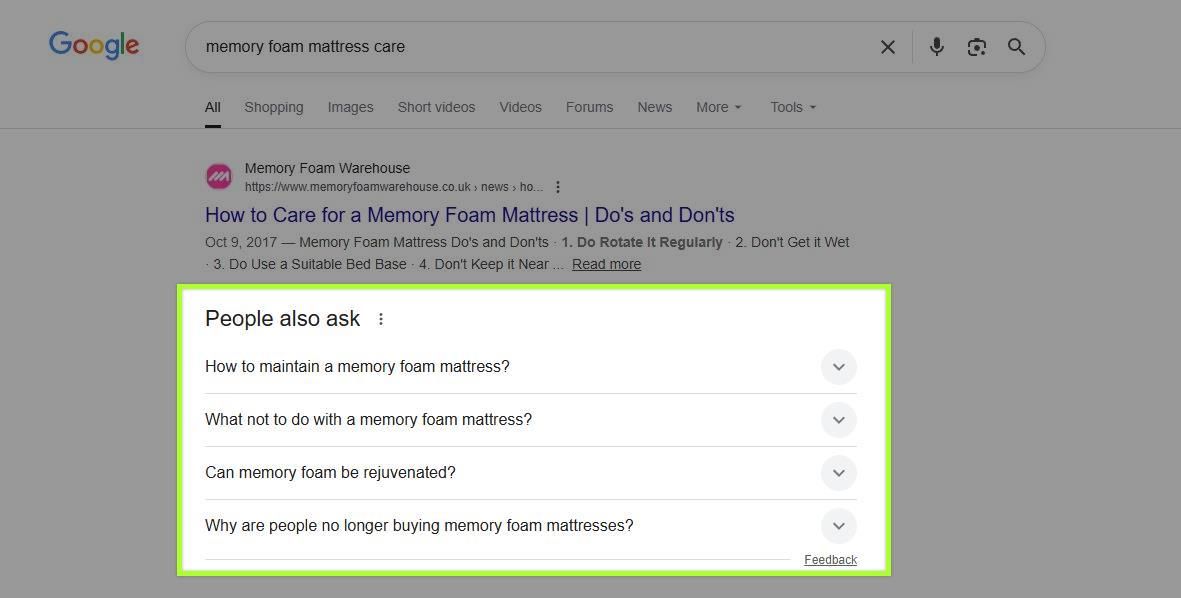
However, structured FAQ content is easier for Google to parse. Clear, well-organized Q&A pairs have a better chance of being referenced in these features than the same information buried in paragraphs. FAQ schema does not guarantee inclusion, but it improves readability.
FAQPage Schema Requirements
Valid FAQ schema requires specific formatting. Whether or not rich results display, incorrect schema provides no benefit.
Technical Requirements
The page must include FAQPage structured data, typically in JSON-LD format embedded in the page source. Each FAQ must be marked up with:
- A Question type containing the question text
- An Answer type containing the answer text
- Proper nesting within the FAQPage structure
Common errors that invalidate schema:
- Missing @type declarations for Question or Answer
- Incorrect property names
- Improper nesting of answers within questions
- Syntax errors like missing brackets or commas
Content Requirements
Google also evaluates the quality of FAQ content:
- Schema content must match visible page content exactly.
- FAQs must be informational and genuinely answer questions.
- Content cannot be promotional, misleading, or used for advertising.
- The page must follow Google's webmaster guidelines.
Even perfect technical implementation does not guarantee any specific outcome. But invalid schema guarantees nothing will work - not rich results, not improved content understanding, not AI extraction.
How Risify Generates Valid FAQ Schema
Risify removes the technical barriers that cause most FAQ implementations to fail.
Automatic Schema Generation
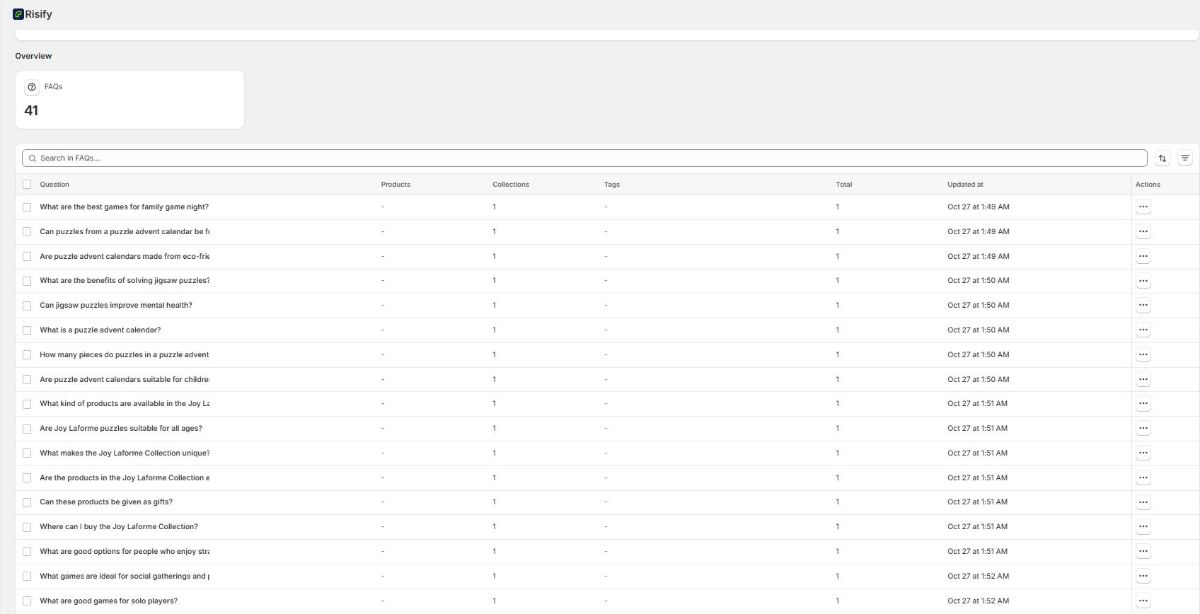
When you create FAQs in Risify and assign them to products or collections, the app outputs valid FAQPage schema automatically. You do not need to write JSON-LD manually or understand schema syntax. The structured data is generated from the same FAQ entries that display visually on your page.
Content Synchronization
Both the visible FAQ and the schema come from the same source - the FAQ entries you create in the Risify admin. When you update a question or answer, both outputs update together. There is no drift or mismatch between what users see and what machines read.
Native Shopify Storage
Risify stores FAQ data in Shopify metafields. The content is native to your store and persists reliably. Your FAQ data remains in Shopify even if you uninstall the app.
This approach ensures your pages have properly structured FAQ data that search engines and AI systems can read, without requiring technical expertise to implement.
Structure Your FAQ Content with Risify
FAQ schema makes your Q&A content readable to search engines and AI systems. While Google has limited traditional rich result displays, structured FAQ data still helps machines understand your content and can improve visibility in AI-powered search experiences.
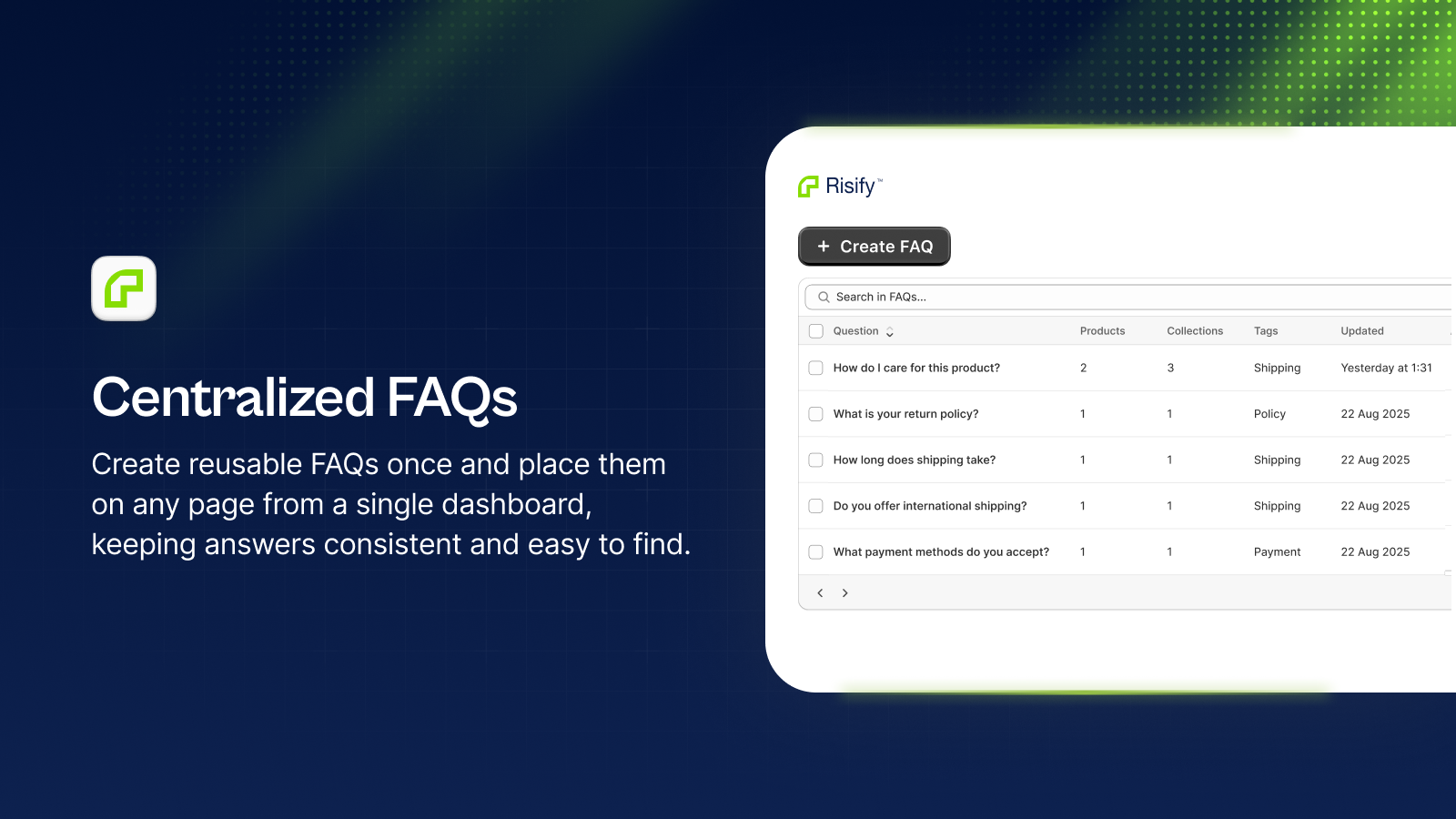
Risify generates valid FAQPage schema automatically from the FAQs you create, ensuring your content is properly structured for both current and emerging search technologies.