




Getting a Shopify store discovered through Google, ChatGPT, Perplexity, or AI-generated search results starts with one basic question: can these systems clearly understand what the store sells?
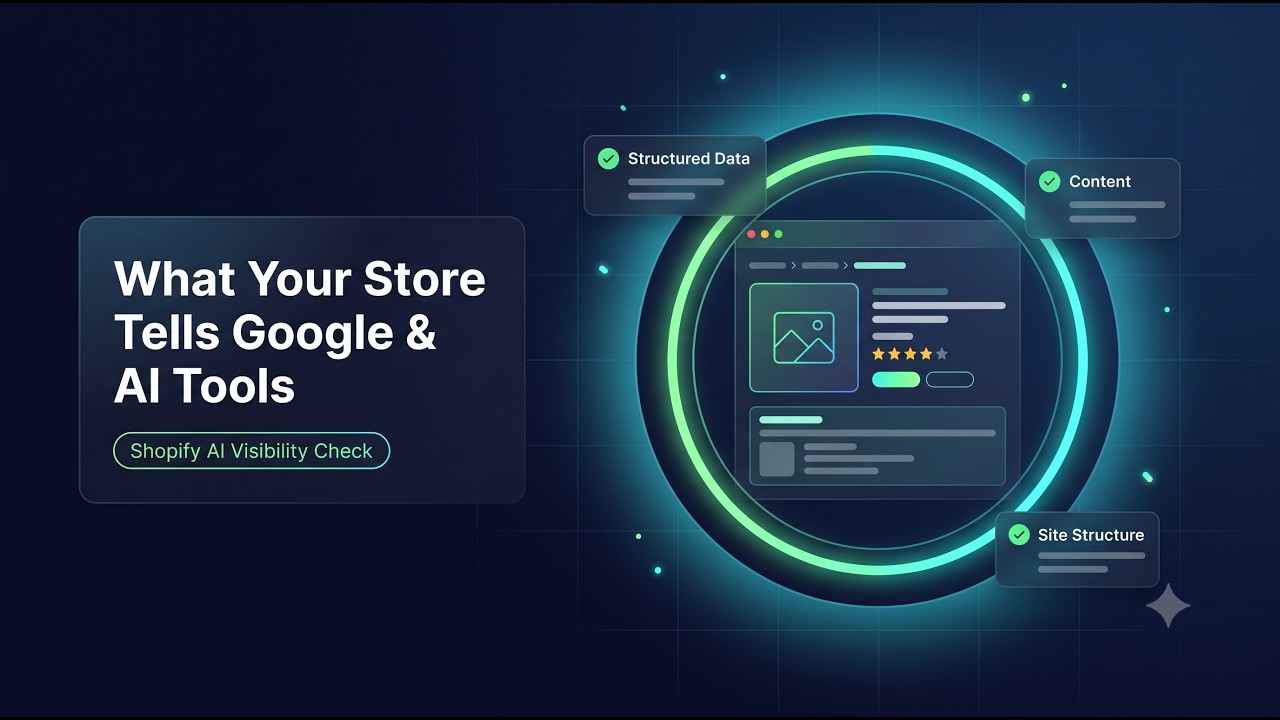
You cannot directly control which products a search engine ranks or which brands an AI platform recommends. You can control the information your store provides when crawlers access it. That information generally comes from three areas: structured data, the visible content on your pages, and the way those pages are connected across the store.
A weakness in any of these areas can make products and collections harder to interpret. A store may have detailed product pages but poor internal linking. It may have strong content but incomplete structured data. It may also have all the necessary schema types but several apps producing conflicting versions of the same information.
We recently published a practical walkthrough showing how to review all three areas on a real Shopify store.
Watch the full Shopify store walkthrough on YouTube
Your Shopify Store May Be Missing These AI Visibility Signals
Key Takeaways
AI visibility starts with clarity
Search engines and AI platforms need clear information before they can understand a store, its products, and its categories.
This does not guarantee rankings, citations, or recommendations. It gives these systems a stronger foundation when they crawl and process the store.
Three main signals shape how a store is understood
The first signal is structured data. This provides labeled information about products, categories, policies, and the business itself.
The second is page content. This gives search engines and AI systems factual information they can summarize, compare, quote, or use when answering questions.
The third is site structure. This determines how easily crawlers can discover pages and understand the relationships between them.
Structured data removes unnecessary interpretation
Structured data is usually added to a page through JSON-LD code. It communicates information in a machine-readable format.
On a product page, this can include:
- Product name
- Description
- Brand
- Images
- Price
- Currency
- Availability
- Product URL
- Ratings
Without this labeled information, crawlers must rely more heavily on the visible page and attempt to interpret which values represent the price, brand, availability, or other product details.
Shopify’s default schema is often only a starting point
Many Shopify themes output a basic Product schema block. The exact fields depend on the theme, but the output commonly includes the product name, image, description, brand, price, currency, availability, and URL.
That basic implementation may still be missing several useful elements, including:
- Product-specific rating data
- Merchant return policy information
- Breadcrumb schema
- A complete Organization block
- Links to official brand profiles
Store owners should check the actual output rather than assuming every required field is already included.
Ratings should be connected to the individual product
Review apps do not always add rating information directly to the main Product schema.
In some cases, the rating appears in a separate block. This can make the relationship between the product and the rating less clear. Other setups repeat the same store-wide rating across every product page, even when individual products have different review histories.
The preferred setup is product-level rating data connected directly to the relevant product.
6. Return policy pages and return policy schema are different
A store may have a complete return policy page while providing no structured return information on its product pages.
MerchantReturnPolicy schema can communicate details such as:
- The number of days available for returns
- The refund method
- Return conditions
- Return shipping responsibilities
- The countries covered by the policy
This gives search engines and AI systems a labeled version of the policy rather than requiring them to extract the correct terms from a general policy page.
Breadcrumbs have both a visible and technical role
Visible breadcrumbs help visitors understand where they are within the catalog.
For example:
Home > Jigsaw Puzzles > 500 Piece Puzzles > Product
Breadcrumb schema communicates the same hierarchy to crawlers. It helps clarify which category a product belongs to and how that product fits into the wider store structure.
The visible breadcrumb and the structured data version should follow the same path.
Conflicting schema can weaken otherwise correct data
Multiple apps and theme components may generate structured data on the same page.
A theme might output one Product block, a review app might output another, and an SEO app might add a third. These blocks can contain different prices, ratings, availability values, or brand details.
Even when one version is complete, conflicting alternatives can make it harder for crawlers to determine which version is accurate.
Structured data audits should therefore look for duplication and disagreement, not only missing fields.
Schema scores should be treated as diagnostic indicators
A low schema score does not automatically mean a store is invisible to Google or AI tools.
It usually means the store is sending less information than it could, or that some of the information may be incomplete or conflicting.
A schema score is useful for identifying gaps. It should not be treated as a prediction of rankings or recommendations.
Collection pages need more than products
Many Shopify collection pages contain a short introductory sentence followed by a product grid.
That structure provides very little information about the category itself. Search engines may see the products, but they receive limited context about how those products relate to one another or what makes the collection useful.
A stronger collection page can include:
- A short introduction above the product grid
- A detailed description below the products
- Information about materials, styles, use cases, or product types
- Relevant questions and answers
These sections give search and AI systems more factual information to process.
Generic product descriptions provide little value
Descriptions built around phrases such as “high quality,” “beautiful,” or “perfect for everyone” do not explain much about the product.
A stronger description should answer practical questions:
- What is the product?
- What is it made from?
- What are its dimensions or specifications?
- Who is it designed for?
- How is it different from similar products?
- Are there any important care or usage instructions?
This information helps shoppers make decisions and gives AI systems clear facts to use when answering product-related questions.
Navigation determines which pages are easy to discover
A clear navigation menu should reflect the way the catalog is organized.
For example:
Homepage > Main Category > Subcategory > Product
This creates a logical route for visitors and crawlers. Important collections that are absent from the navigation and receive few internal links can become difficult to discover.
A visually simple menu is not always a well-structured menu. The hierarchy should also represent the store’s main categories and subcategories accurately.
Breadcrumbs should not change based on the visitor’s route
Some Shopify themes generate breadcrumbs based on the page a visitor used to reach a product.
As a result, the same product may appear under different category paths depending on the previous page. A visitor arriving from one collection may see one breadcrumb, while someone arriving from another page sees a different one.
A fixed breadcrumb hierarchy gives the product a stable primary category. This creates a more consistent signal for visitors and crawlers.
Related collections strengthen internal linking
A collection page should provide routes to other relevant parts of the catalog.
Related collections, collection menus, and related search links can help visitors continue browsing. They also create internal links to deeper collection pages that may not fit inside the main navigation.
These links should reflect genuine relationships between categories. Their purpose is to improve discovery and clarify the catalog structure.
Important pages should not be buried too deeply
A simple way to review site structure is to start from the homepage and try to reach a deeper product using only the navigation and internal links.
Count the number of clicks required.
When important products take more than three or four clicks to reach, visitors and crawlers may be working too hard to find them. This can point to gaps in the menu, collection hierarchy, or internal linking.
Final Thoughts
A Shopify store communicates with search engines and AI tools through more than its product titles and images.
Structured data provides labeled information. Page content adds facts and context. Site structure helps crawlers reach pages and understand how products and collections relate to one another.
Reviewing these three areas will not guarantee that a product appears in Google, ChatGPT, Perplexity, or another platform. It ensures that the store provides clear and complete information when those systems access it.