




Risify and StoreSEO solve different problems. StoreSEO optimizes individual products: meta tags, alt text, images and schema, with a free plan for small catalogs. Risify optimizes the whole store: catalog structure, structured data, FAQs and content, and it tracks whether AI tools and search engines respond. Risify also includes expert support on every plan.
Risify is our own app, so read this comparison with that in mind. We have kept to what each app states on its Shopify App Store listing, and we say where StoreSEO is the better choice.
Key takeaways
- StoreSEO works product by product. Risify works on how the whole store is organized and understood.
- Risify tracks whether ChatGPT, Claude and Google AI Mode mention your store. StoreSEO’s listing does not describe this kind of tracking.
- Risify builds breadcrumbs, collection menus and related searches. StoreSEO’s listing does not describe collection navigation tools.
- StoreSEO has a free plan and costs less for small catalogs. For catalogs above 250 products, Risify Standard costs less than StoreSEO’s top plan.
- Every Risify plan includes expert support, and Risify Plus includes done-for-you work.
Risify vs StoreSEO at a glance
| Risify | StoreSEO | |
|---|---|---|
| Made by | Solverhood, the team behind Analyzify | Storeware |
| Works on | The whole store: structure, structured data, FAQs, content | Individual products, images and meta tags |
| AI mention tracking | Yes: ChatGPT, Claude, Google AI Mode | Not described on its listing |
| Navigation tools | Fixed breadcrumb paths, collection menus, related searches | Breadcrumbs listed as a feature tag; collection menus and related searches not described |
| FAQs on products and collections | Yes, reusable, with FAQ schema | FAQ schema |
| Audit | 100+ checkpoints, compared over time | SEO score and reports |
| Keyword tracking | 100 keywords on Standard, 1,000 on Plus | Up to 5 keywords on the free plan |
| Image compression | No | Yes |
| Expert support | Included on every plan | 24/7 chat support |
| Done-for-you work | Yes, on Risify Plus | Not described on its listing |
| Plans limited by | Tracked keywords, audits and AI credits | Number of products |
| Free plan | No | Yes, for 25 products |
| Paid plans | $145 and $745 a month | $19.99, $39.99 and $249.99 a month after a discounted first month |
What does Risify do?
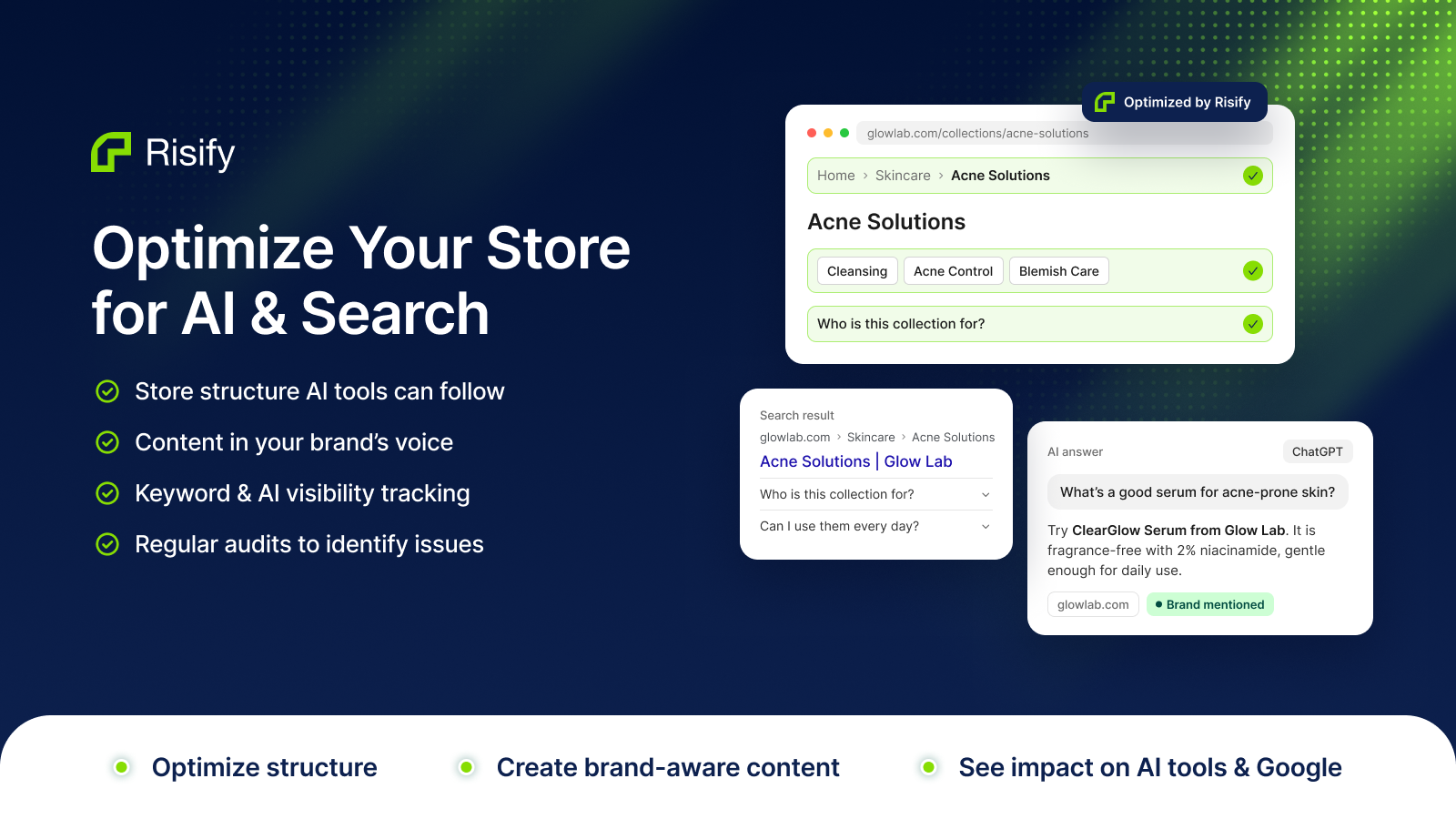
Risify is a Shopify app that optimizes a store’s AI and search visibility by fixing its structure, content and signals, and tracks the result. It works inside the Shopify admin and uses Shopify’s native tools, with no external scripts.
Risify starts from one idea: search engines and AI tools recommend what they can understand. So it works on the parts of a store that explain it.
- Navigation: fixed breadcrumb paths, collection menus and related searches, so shoppers and crawlers can follow your catalog.
- Structured Data: seven schema types, including Product, Breadcrumb, FAQ, Article and Organization.
- FAQs: reusable FAQs that you assign to products and collections, shown on the page with FAQ schema.
- Meta Tags and Page Optimization: bulk editing with flags for missing, long and duplicate tags.
- Risify AI: content written to brand instructions that you set once.
- AI & Search Audit: more than 100 checkpoints, covering broken links, meta issues, page speed and schema errors, with comparison against earlier audits.
- AI & Search Visibility: AI Visibility tracking, keyword rankings and Search Console data in one place.
Risify has two plans. Standard is $145 a month and includes a one-on-one onboarding call and expert support. Plus is $745 a month and adds done-for-you work: managed onboarding, schema set up by the Risify team, and full FAQ coverage for collections and products.
What does StoreSEO do?
StoreSEO is an SEO and image optimization app for Shopify. According to its listing, it helps merchants optimize products in bulk with AI: meta titles and descriptions, image alt text, JSON-LD schema, sitemaps and an llms.txt file.
Its main features, as listed:
- Product SEO: meta titles and descriptions with a preview before you publish, plus an SEO score for each product.
- Image optimizer: compress and resize images and generate alt text in bulk.
- Technical SEO: JSON-LD and FAQ schema, local SEO, sitemap submission and indexing requests.
- AI content: AI credits for writing meta tags, product content and blog posts.
- Reporting: Google Search Console and Google Analytics connections, plus keyword tracking.
- AI files: an llms.txt generator and an agents.md editor.
- AI assistant connector: a way to let Claude or ChatGPT make SEO edits through StoreSEO.
StoreSEO’s free plan covers 25 products. Paid plans raise the limit: 100 products on Lite, 250 on Essential and 10,000 on Advanced, which also adds multilingual SEO.
How do Risify and StoreSEO differ?
The two apps overlap on meta tags, schema and AI content. They differ most on store structure, AI visibility, support and how they charge.
Store structure and navigation
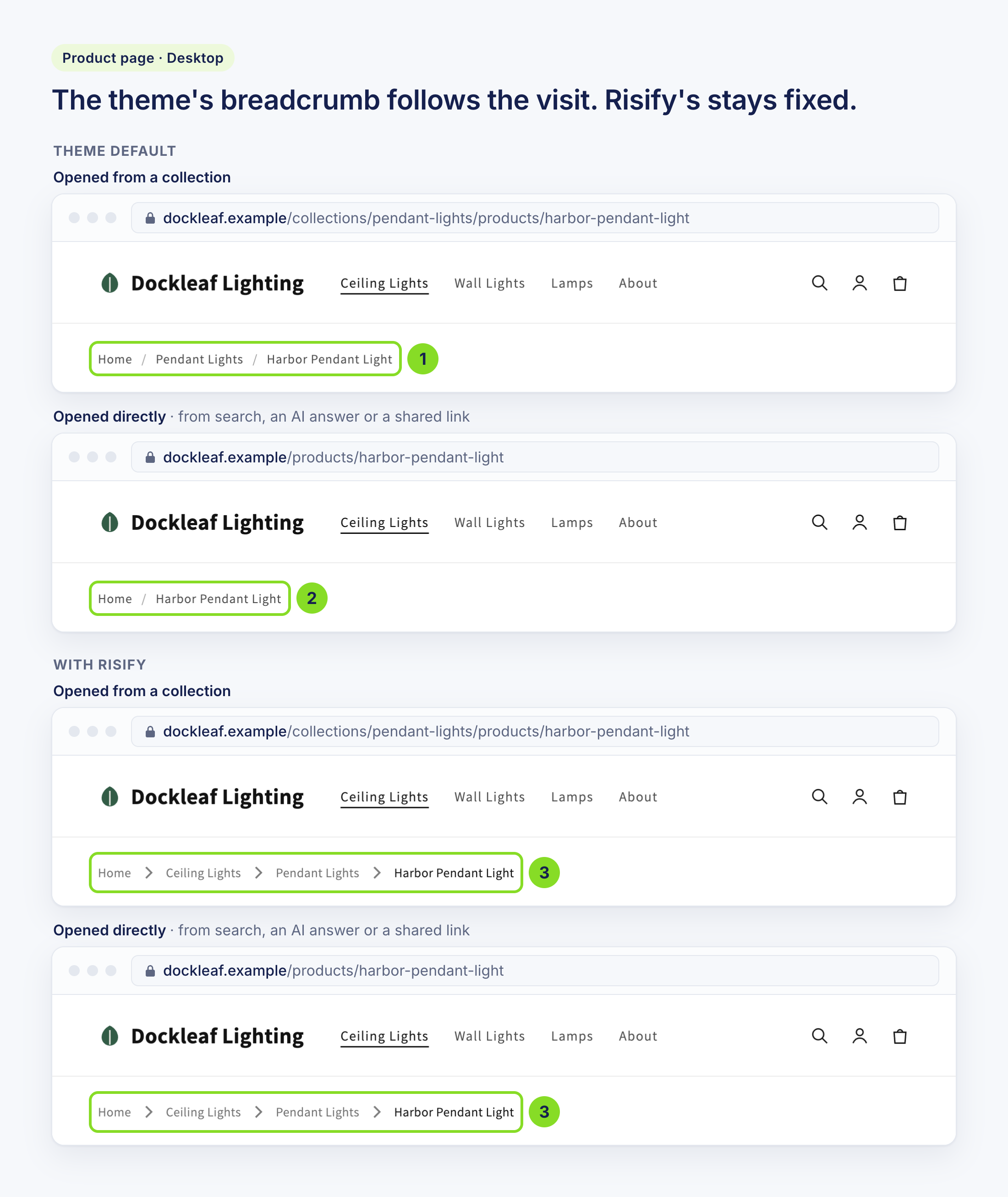
This is where Risify does work StoreSEO does not describe. Shopify’s default breadcrumbs change with the path a visitor takes, and collections have no built-in hierarchy. On a store with many collections, search engines and AI tools cannot see how the catalog fits together.
Risify lets you set a fixed breadcrumb path for every product and collection, add collection menus that link to subcategories, and add related searches. These create internal links that give your catalog a clear shape. We cover the problem in Shopify Breadcrumbs: How to Check and Fix.
StoreSEO’s listing focuses on products, images and technical SEO.
AI visibility
StoreSEO works on inputs for AI search: an llms.txt file, schema and AI-written content. Shopify now provides llms.txt for stores automatically, so the file matters less than it did.
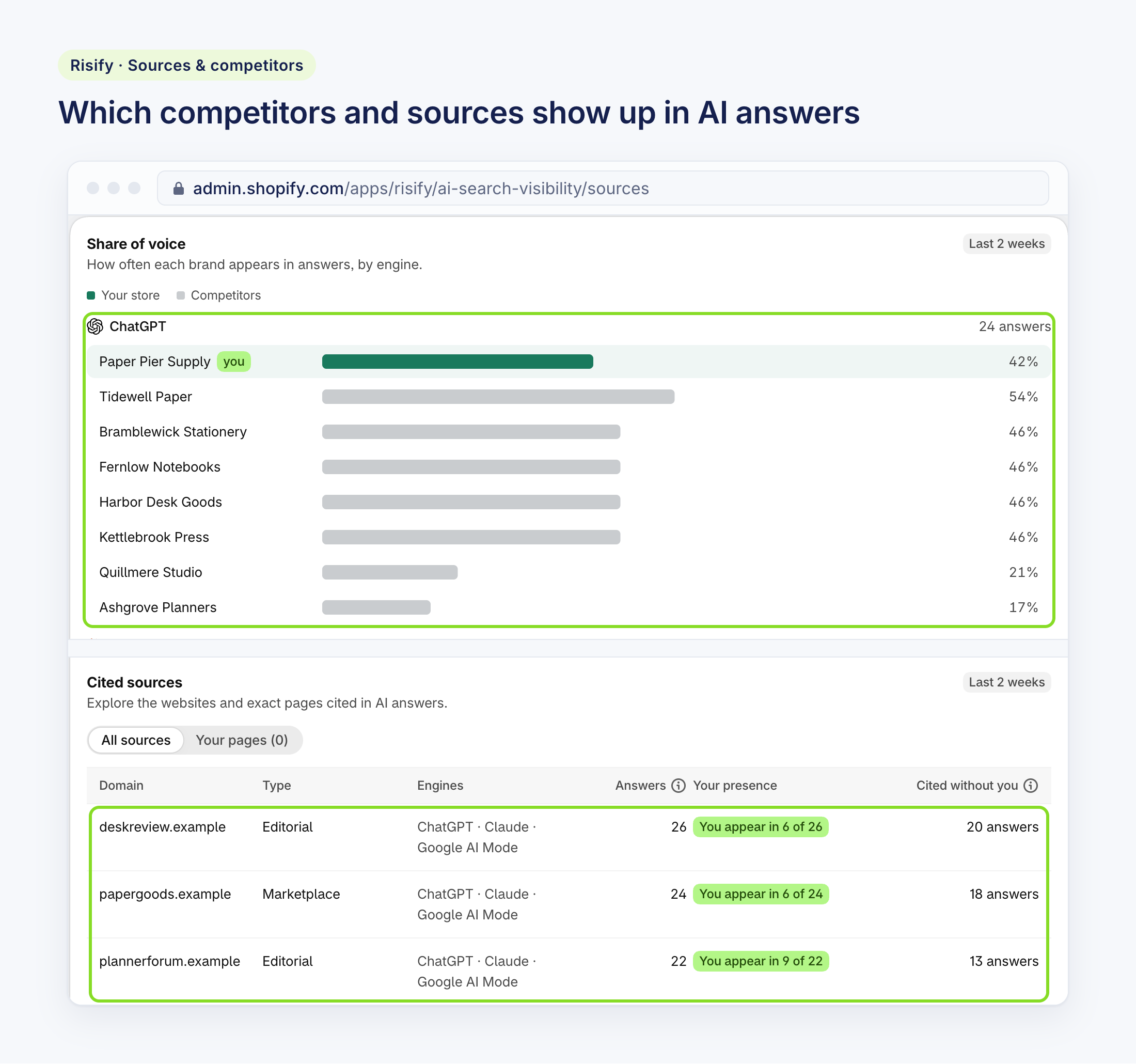
Risify works on inputs too, with structured data, on-page FAQs and navigation. It also measures the result. AI Visibility runs shopper-style prompts on ChatGPT, Claude and Google AI Mode and shows how often your store is mentioned or cited as a source, and which competitors and sources appear. That feedback tells you which pages to improve next.
Structured data and FAQs
Both apps add structured data. StoreSEO lists JSON-LD, FAQ schema and local SEO schema. Risify adds seven schema types and reports schema errors in its audit.
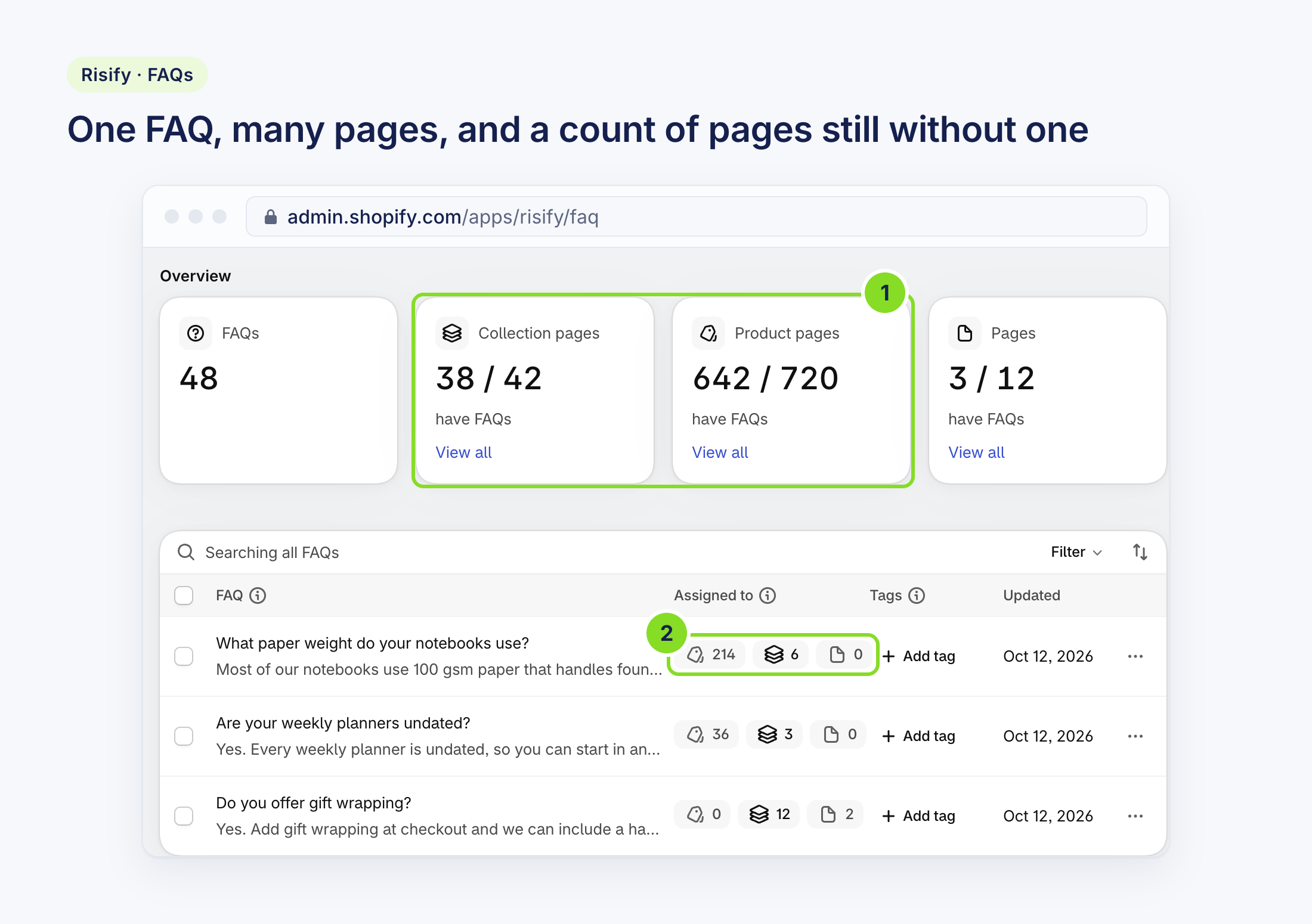
Risify goes further on FAQs. You write an FAQ once, assign it to many products and collections, and it appears on the page with FAQ schema. A coverage view shows which pages still have none. For AI tools, visible questions and answers on product and collection pages are useful source material.
Content
Both apps use AI credits. StoreSEO includes more credits for the price and can write blog posts. Risify includes 50 credits a month on Standard and 500 on Plus, and its content follows your brand instructions so it sounds like your store.
If volume of AI content is your main need, StoreSEO offers more.
Images and speed
StoreSEO compresses and resizes images and writes alt text in bulk. Risify reports page speed in its audit but does not compress images. If image optimization is on your list, StoreSEO covers it.
Support
StoreSEO lists 24/7 chat support on every plan. Risify includes expert support on every plan, starting with a one-on-one onboarding call. On Plus, the Risify team does the setup and ongoing FAQ work for you. Solverhood has built for Shopify merchants since 2017.
Price
For small catalogs, StoreSEO costs less. It has a free plan for 25 products, and its Lite and Essential plans cost $19.99 and $39.99 a month after a discounted first month.
For larger catalogs, the picture changes. StoreSEO’s plans are limited by product count. Above 250 products, the next plan is Advanced at $249.99 a month. Risify Standard is $145 a month and is not limited by product count. So a store with 1,000 products pays less for Risify Standard than for StoreSEO Advanced, and gets structure tools, AI Visibility tracking and expert support.
Risify has no free plan or free trial.
Who should choose Risify?
Choose Risify if:
- Your catalog has more than a few hundred products.
- Your collections, breadcrumbs and internal links need work.
- You want to know whether AI tools mention your store, and track it over time.
- You want schema, FAQs, navigation, meta tags, audit and tracking in one app.
- You want experts to guide the setup, or to do it for you.
Bad.no, a Norwegian retailer with more than 30,000 products, grew organic sessions by 132% over 8 quarters with Risify’s structure-first approach. The Bad.no case study has the details.
Who should choose StoreSEO?
Choose StoreSEO if:
- Your main tasks are meta tags, alt text and images.
- You want to do the work yourself.
- You need image compression in the same app.
- You want a large number of AI credits for content.
Conclusion
StoreSEO is a good fit for small stores that want a free or low-cost way to optimize products and images themselves. Risify is built for stores that want more than product-level fixes: a clear catalog structure, complete structured data and FAQs, tracking across AI tools and search, and a team that helps.
If your store is growing and visibility matters to your revenue, Risify gives you the foundation and the feedback in one app. Our guide on how to fix Shopify SEO and AI visibility gaps shows what to look for, and you can find Risify on the Shopify App Store.