



Choose an SEO app when you need your store’s foundation fixed: structure, structured data, on-page content and tracking. Choose an agency when you need strategy, link building, PR or content at volume. Many stores pay an agency for foundation work that an app now does faster and for less, and that their own team can run.
This guide compares the two on cost, speed, control and the skills you need. It also covers the middle option, an app that comes with a team, for stores that want the work done without a retainer.
A note on who is writing: Risify is our Shopify app. We have tried to be fair to agencies, because good ones do things no app can.
Key takeaways
- An app changes your store directly. An agency advises, and often depends on a developer to make the changes.
- The average SEO agency retainer is about $3,209 a month, according to Ahrefs’ survey of SEO providers. Shopify SEO apps cost a fraction of that.
- Foundation work, such as breadcrumbs, structured data, FAQs and audits, can now be done in-house, without code.
- Agencies still lead on strategy, link building, PR and large content programs.
- A third option exists: an app with expert support and done-for-you setup.
What does an SEO agency do for a Shopify store?
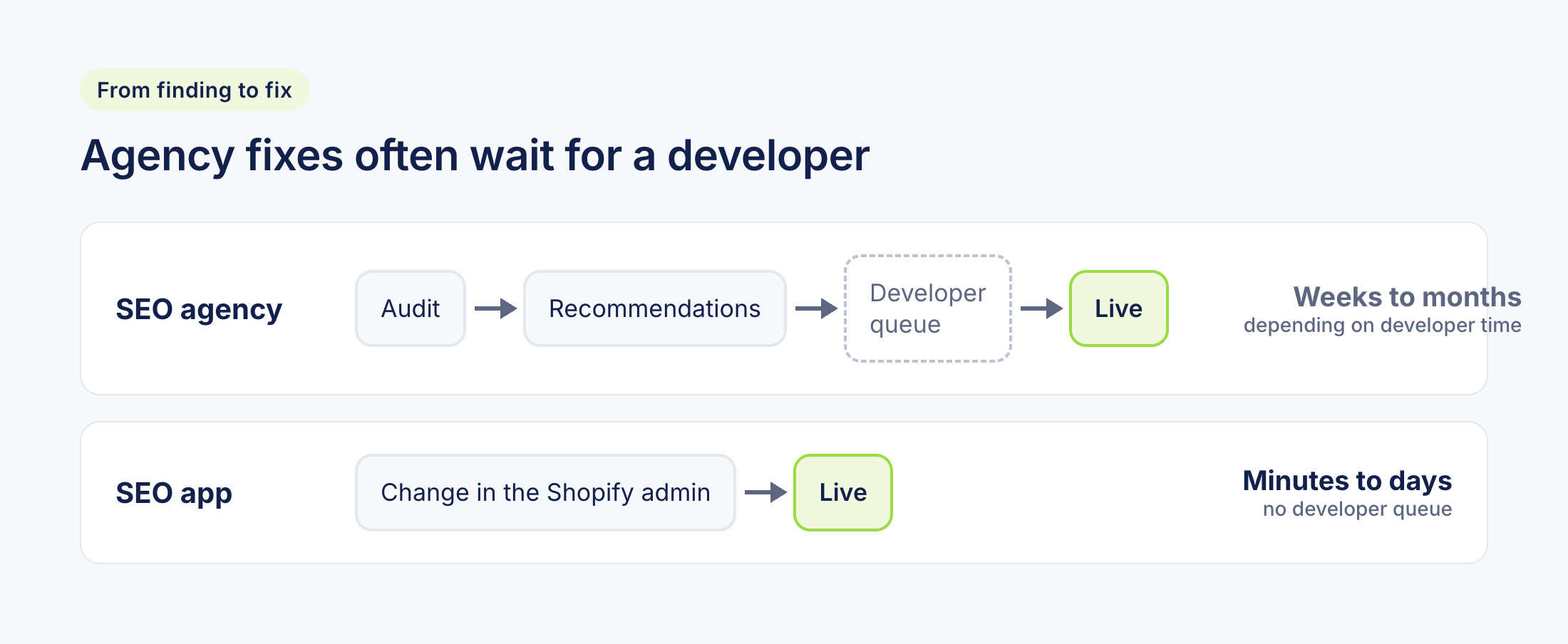
An SEO agency provides people and judgment. A typical engagement includes:
- An audit of the store, with a list of issues and recommendations.
- Keyword and competitor research, and a plan for which pages should target what.
- Technical recommendations, such as schema, breadcrumbs and internal linking, usually handed to a developer.
- Content, such as collection descriptions, blog posts and meta tags.
- Link building and digital PR.
- Monthly reporting and calls.
The value is in the thinking and in the work that needs human relationships, such as PR. The weak point is implementation. Many recommendations need theme changes, so they wait for a developer. An audit can sit for months before the fixes go live.
What does a Shopify SEO app do?
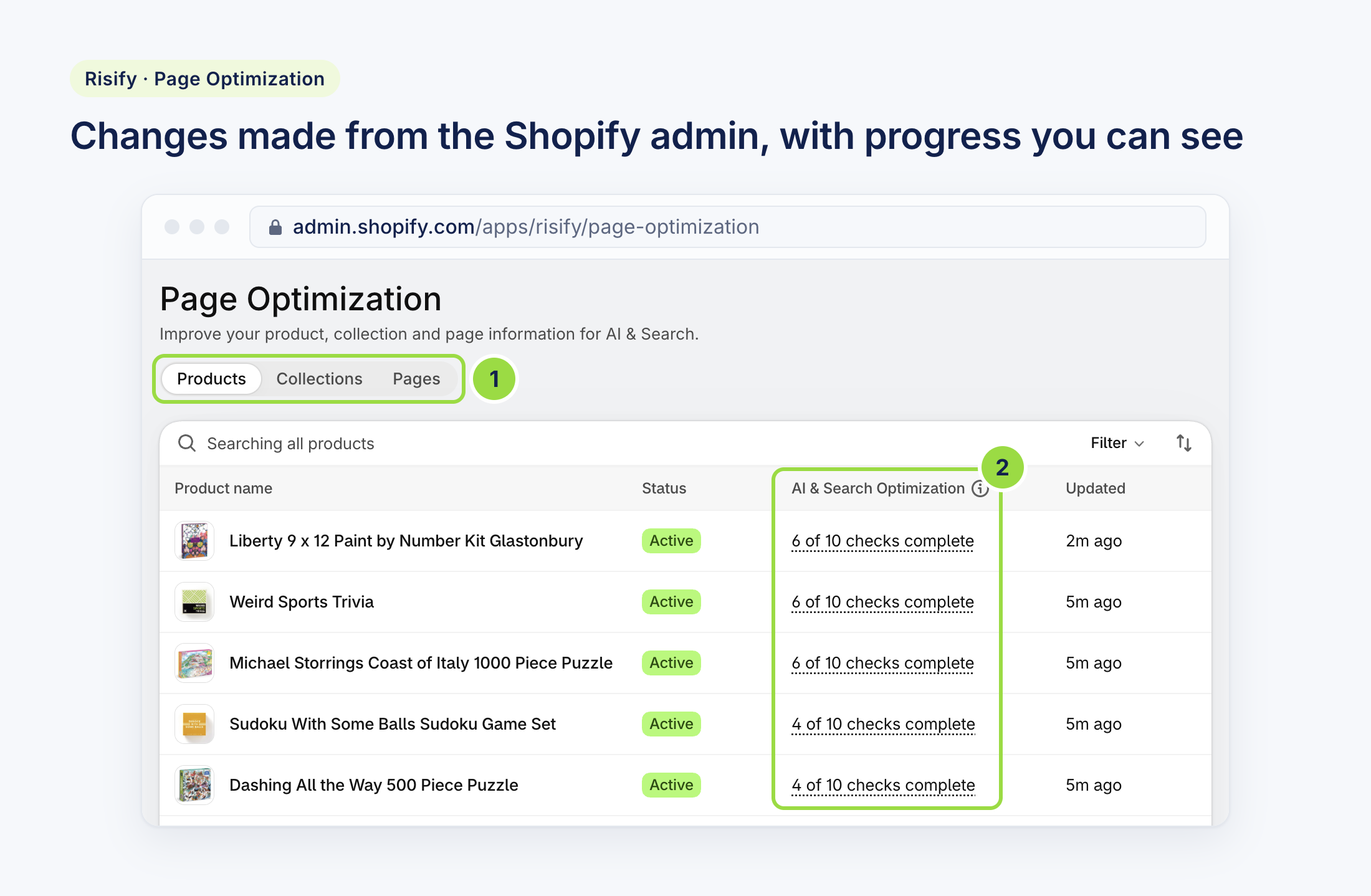
An SEO app provides tools that change the store directly, from the Shopify admin. Depending on the app, it can:
- Set breadcrumbs and links between collections.
- Add structured data across the catalog.
- Add FAQs to product and collection pages.
- Edit meta tags in bulk and write content with AI.
- Run audits on a schedule and compare them.
- Track keyword rankings and AI mentions.
The value is speed and control. A change takes minutes, not a sprint, and you can see what was done. The limit is that a tool does not decide your strategy or earn you a link from a magazine.
SEO app vs SEO agency, side by side
| SEO app | SEO agency | |
|---|---|---|
| What you get | Tools that change the store | People who analyze, advise and produce |
| Who makes the changes | You or your team, in the Shopify admin | Often a developer, on the agency’s recommendation |
| Time to implement a fix | Minutes to days | Weeks to months, depending on developer time |
| Cost | A monthly subscription | A monthly retainer, often with a minimum term |
| Control and visibility | You see every change | You see reports |
| Strategy and research | Limited; some guidance and suggestions | A core strength |
| Link building and PR | No | Yes |
| Skills you need | Knowledge of your catalog; little SEO training with the right app | Time to brief, review and approve |
| What you keep if you stop | Depends on how the app stores its work | The recommendations, and whatever was built in your theme |
What does each cost?
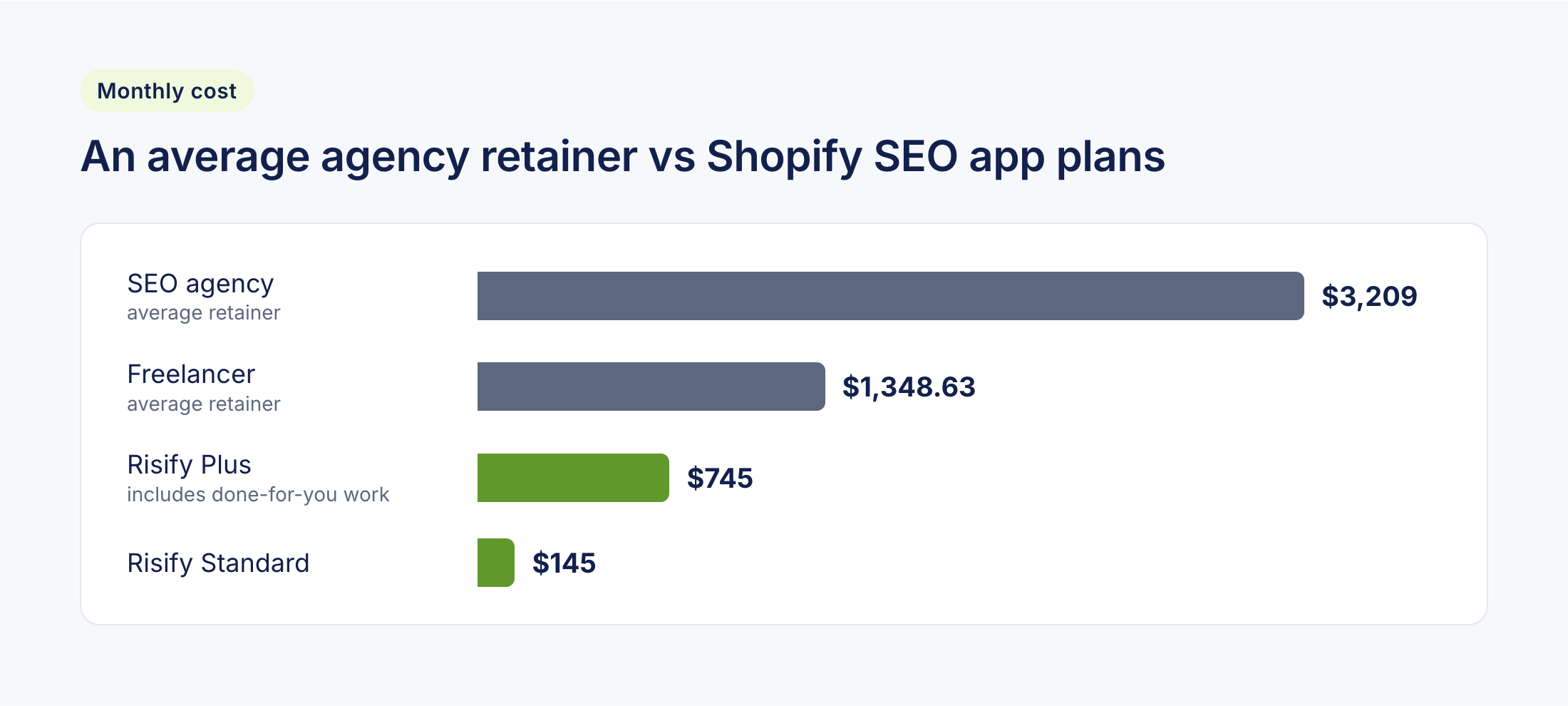
Agencies and freelancers. Most SEO providers charge a monthly retainer. In Ahrefs’ pricing survey of 439 SEO providers, 78.2% charged this way. The average retainer was $3,209 a month for agencies and $1,348.63 a month for freelancers. Prices vary widely with scope and experience, and content or development work is often billed on top.
Apps. Shopify SEO apps range from free plans to a few hundred dollars a month. Risify Standard is $145 a month and Risify Plus is $745 a month, which includes done-for-you work.
Price alone is not the comparison, because the two do different things. The useful question is what you are paying an agency for. If most of the retainer goes to an audit, schema, breadcrumbs, FAQs and reporting, an app can do that work for far less. If it goes to strategy, content and links, an app does not replace it.
Which SEO work can your own team do now?
A few years ago, the honest answer was “not much”. Breadcrumbs and schema needed theme code. Bulk content needed a writer. Audits needed a specialist with paid tools.
That has changed. With the right app, a merchant or a small team can do the following from the Shopify admin, without code and without SEO training:
- Give the catalog a structure, with fixed breadcrumbs and links between collections.
- Add complete structured data and see errors.
- Add FAQs to products and collections, written with AI to your brand’s voice and reviewed by you.
- Fix meta tags in bulk.
- Run an audit and track progress.
- See keyword rankings and AI mentions without waiting for a monthly report.
Your team knows your products and customers better than any outside party. Once the tooling stops being the obstacle, that knowledge becomes the advantage. Shopify’s own gaps, and how to close them, are covered in Is Shopify’s Built-In SEO Enough?.
What still needs an agency or a specialist?
Some work stays with people, and it would be misleading to say otherwise.
- Strategy. Deciding which markets, categories and keywords to go after.
- Link building and digital PR. Earning mentions on other sites takes relationships and outreach. This matters for AI visibility too, because AI tools cite third-party sources.
- Content at volume. A blog program, buying guides or video.
- Migrations and replatforming. High-risk projects that need experienced hands.
- International expansion planning.
If these are what you need, an agency or a senior freelancer is the right spend. An app makes their work more effective, because they can build on a sound foundation and stop spending their hours on basics.
When does each option fit?
An app fits when:
- Your main gaps are structure, structured data, FAQs and tracking.
- You have someone who can give this a few hours a week.
- You want changes live quickly and want to see what was done.
- Your budget does not stretch to a retainer.
An agency fits when:
- You need strategy, link building, PR or a content program.
- You are planning a migration or an international launch.
- Nobody on your team can own SEO at all.
Both fit when:
- You have the budget, and you want the agency’s hours spent on strategy and links while the app handles the foundation and the reporting.
The middle option fits when:
- You want the foundation done for you, without a retainer or a long contract. This is where an app with a team behind it comes in.
Should you consider Risify?
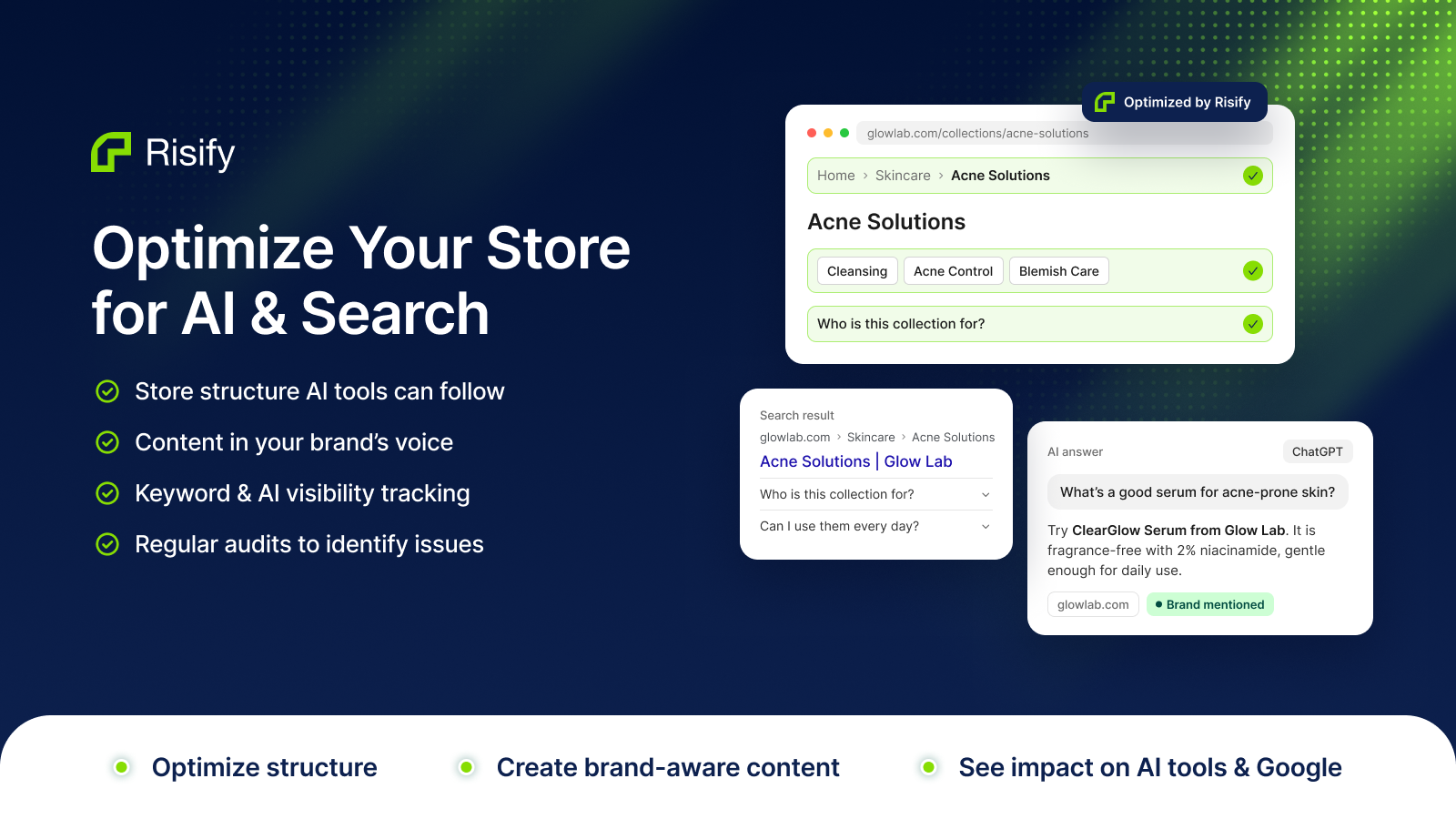
Risify is a Shopify app that optimizes a store’s AI and search visibility by fixing its structure, content and signals, and tracks the result. It was built so a store does not need an agency for the foundation.
If your team does the work: Risify Standard, at $145 a month, gives them the tools and the guidance.
- Navigation: fixed breadcrumb paths, collection menus and related searches.
- Structured Data: seven schema types, with errors flagged.
- FAQs: reusable FAQs for products and collections, with FAQ schema.
- Meta Tags and Risify AI: bulk editing and content written to your brand instructions.
- AI & Search Audit: more than 100 checkpoints, compared over time. See our Shopify SEO audit guide for what an audit should cover.
- AI & Search Visibility: keyword rankings, Search Console data and AI Visibility on ChatGPT, Claude and Google AI Mode.
Every plan includes expert support and a one-on-one onboarding call, so your team is not working alone.
If you want it done for you: Risify Plus, at $745 a month, is the middle option. The Risify team manages onboarding, sets up schema, integrates your catalog and writes FAQs for your collections and products. You get done-for-you foundation work at well under the average agency retainer, and the result lives in your own Shopify admin where you can see it.
It works at scale. Bad.no, a Norwegian retailer with more than 30,000 products, grew organic sessions by 132% over 8 quarters with Risify’s structure-first approach. Read the Bad.no case study.
Risify does not do link building, PR or SEO strategy consulting, and it cannot guarantee rankings or AI recommendations. If you work with an agency for those, Risify gives them a store that is ready to build on. Teams at larger brands can read more in SEO and AI Visibility for Shopify Plus Stores.
How to move foundation work in-house
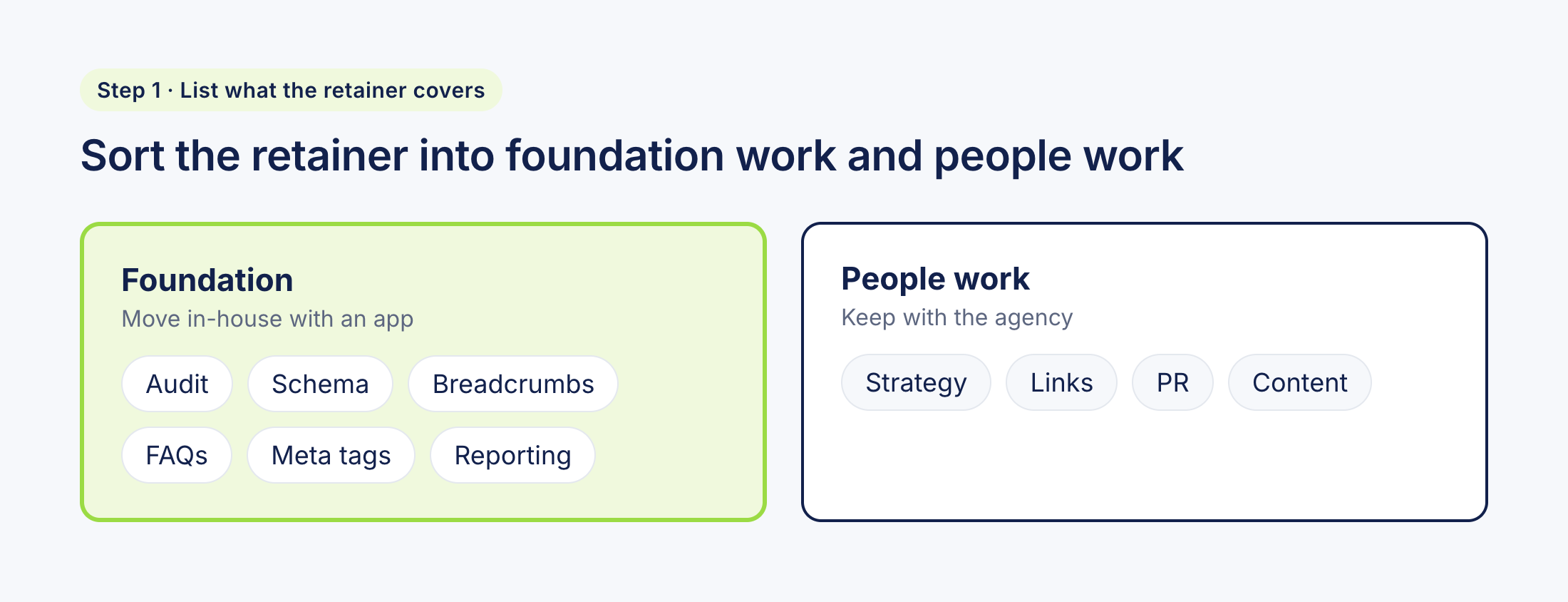
If you are paying a retainer today and want to bring the foundation in-house, do it in steps.
- List what the retainer covers. Mark each item as foundation (audit, schema, breadcrumbs, FAQs, meta tags, reporting) or people work (strategy, links, PR, content).
- Pick one owner on your team. A few hours a week is enough to start.
- Set up the app and run an audit to get a baseline.
- Fix structure and structured data first, then FAQs on your top collections and products.
- Track rankings and AI mentions so you can report progress yourself.
- Review the agency scope. Keep what needs people. Reduce or end what the app now covers.
Conclusion
An SEO app and an SEO agency are not the same purchase. An app changes your store. An agency brings judgment, relationships and production. For years, stores paid agencies for both, because there was no other way to get the foundation built.
There is now. Your own team can give the catalog a structure, complete its structured data, put answers on its pages and track the results, and Risify gives them the tools and the experts to do it, or does it for them on Plus. You can find Risify on the Shopify App Store.