



AI visibility tracking tells you whether AI tools mention your store. AI visibility optimization changes what those tools can read and understand about your store. Tracking measures the result. Optimization works on the cause. A Shopify store needs both, and optimization should come first.
This matters because many merchants start with a tracking tool, see that ChatGPT does not mention them, and then have no next step. This guide explains what each approach does, where each one stops, and how to combine them.
Key takeaways
- Tracking answers one question: do AI tools name my store when shoppers ask about what I sell?
- Optimization improves the things AI tools read: structured data, FAQs, product and collection content, and store structure.
- Tracking alone does not change any AI answer.
- Optimization without tracking leaves you unable to see what worked.
- Fix the foundation first, then measure, then repeat.
What is AI visibility tracking?
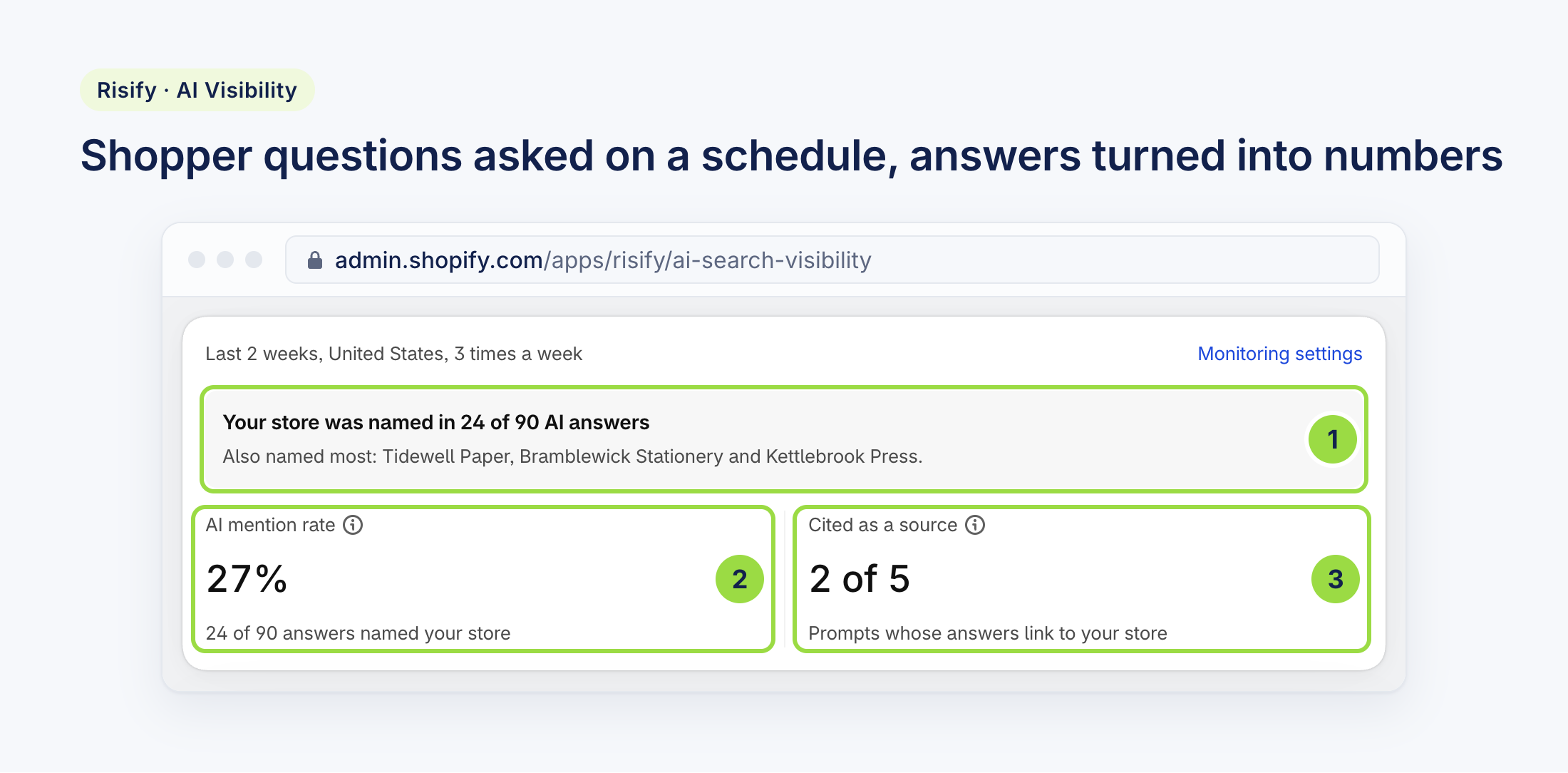
AI visibility tracking is the practice of asking AI tools the questions your shoppers ask, on a schedule, and recording what comes back. A tracking tool does this for you and turns the answers into numbers.
A typical tracking setup shows:
- Mention rate: how often your store or brand is named in the answers.
- Citations: how often your pages are used as a source.
- Competitors: which other brands appear for the same questions.
- Sources: which websites the AI tool relied on.
- Change over time: whether these numbers go up or down.
Tracking is useful because AI answers are hard to observe by hand. They change between runs, between tools and between countries. Asking ChatGPT one question once tells you very little.
What is AI visibility optimization?
AI visibility optimization is the work of making your store easy for AI tools to read, understand and trust. It changes the store itself.
AI tools learn about your store through two channels. Shopify sends product data and store FAQs to partnered AI platforms through its own pipeline. Other systems, including Google’s AI features and Perplexity, read the open web: your pages, your structured data and what other sites say about you. We explain both channels in Shopify Knowledge Base vs Structured Data for AI.
Optimization for the open web usually covers four areas:
- Structured data. Schema markup states facts about your products, pages and business in a format machines read directly.
- FAQ content. Questions and answers on product and collection pages give AI tools ready-made answers to shopper questions.
- Page content. Product descriptions with real specifications and collection descriptions that explain the category.
- Store structure. Breadcrumbs, collection hierarchy and internal links that show how your catalog fits together.
There is evidence that this work matters. Microsoft’s Fabrice Canel confirmed in 2025 that schema markup helps Microsoft’s language models understand content. In a controlled test by Search Engine Land, three near-identical pages were published with different levels of schema, and only the page with well-implemented schema appeared in AI Overviews.
Tracking vs optimization, side by side
| Tracking | Optimization | |
|---|---|---|
| Question it answers | Are AI tools mentioning my store? | Can AI tools read and understand my store? |
| What it changes | Nothing in the store | Structured data, FAQs, content, navigation |
| Output | Reports and trends | A better-structured store |
| Time to set up | Minutes | Days to weeks, depending on catalog size |
| Ongoing work | Review the numbers | Keep content and schema accurate as the catalog changes |
| Main limit | Shows the problem, not the fix | Cannot show whether the fix worked |
Is tracking AI visibility enough?
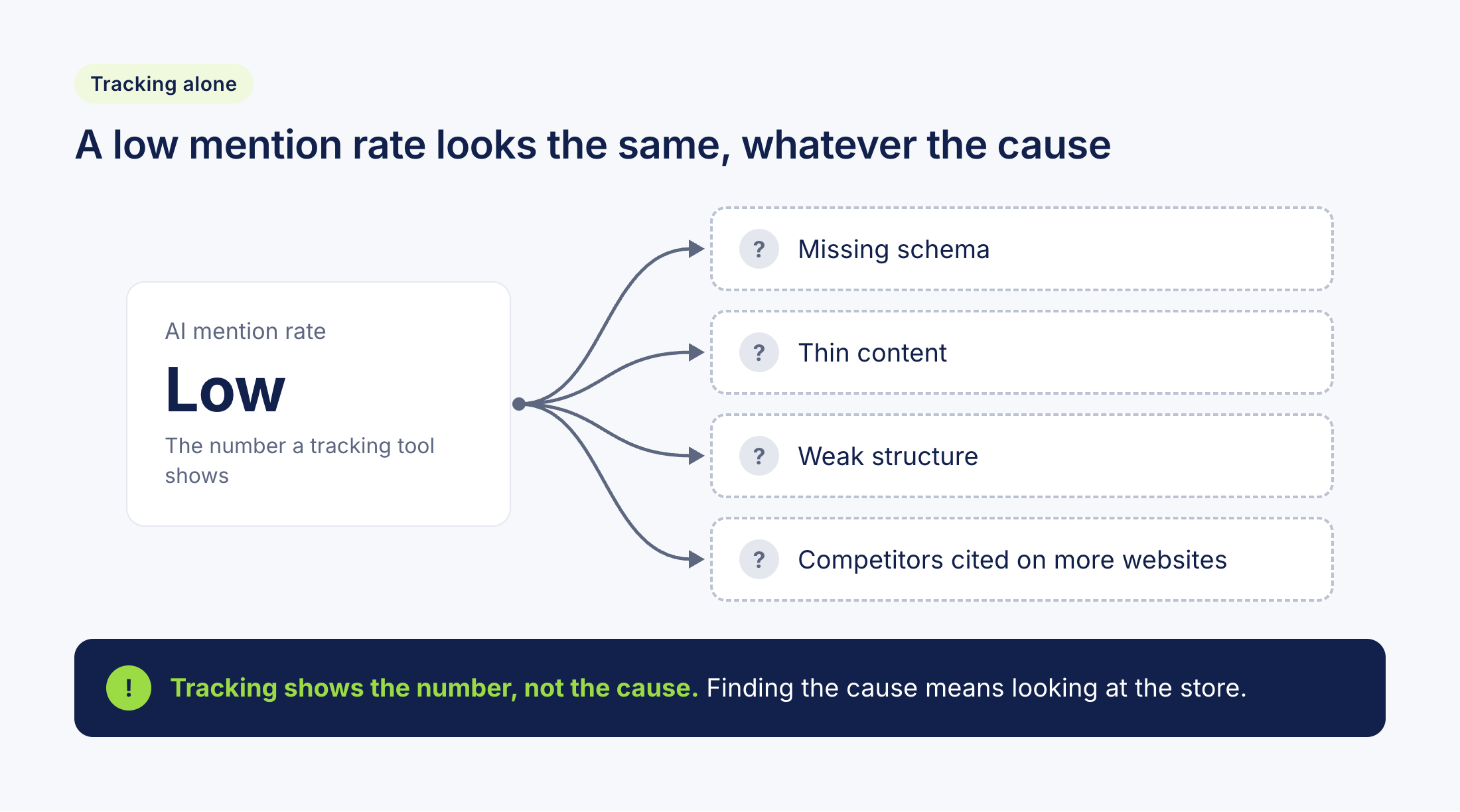
No. Tracking is a measurement, and a measurement does not change the thing it measures. A store that AI tools cannot read will show a low mention rate this month and a low mention rate next month.
Tracking alone has three limits:
- It does not tell you why. A low mention rate can come from missing schema, thin content, weak structure, or simply from competitors being cited on more websites. The number looks the same in each case.
- It does not change anything. No prompt, report or dashboard edits your store.
- It can mislead. AI answers vary. A single week’s change may be noise. Without work on the store, you are watching random movement.
Tracking becomes valuable once you are making changes. Then it shows which changes had an effect.
Is optimization enough without tracking?
Optimization is the more important half, but it is incomplete alone. Without tracking, you cannot see whether your work changed anything, and you cannot see what competitors are doing.
Optimization alone has two limits:
- No feedback. You add FAQs to fifty collections. Did AI tools start citing those pages? Without tracking, you do not know.
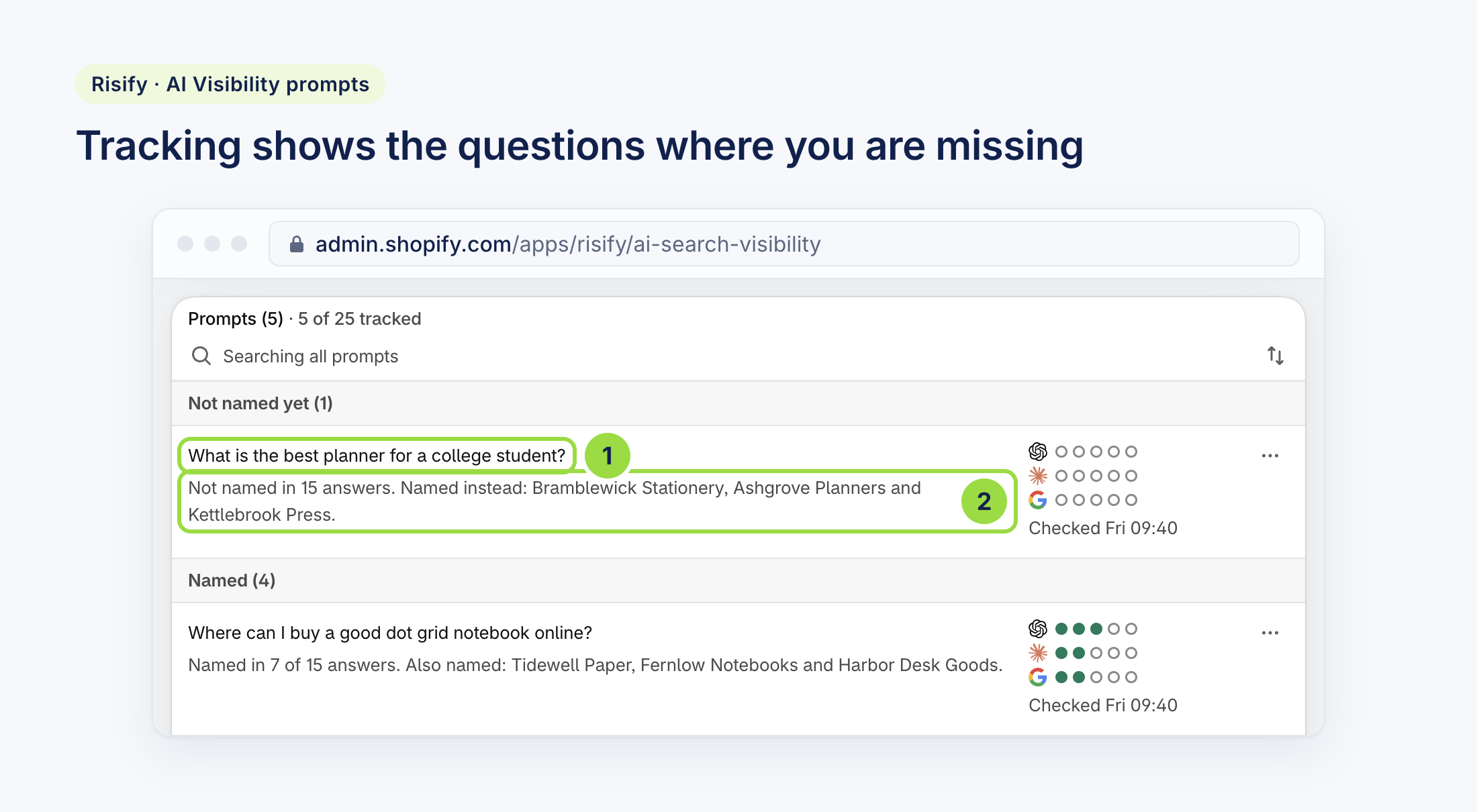
- No priorities. Tracking shows which shopper questions you are missing from. That tells you which collections and products to work on first.
Classic search tracking does not fill this gap. Keyword rankings and Search Console data show how you perform in Google’s regular results. They do not show what ChatGPT or Claude say.
What should you do after you learn your store is not mentioned?
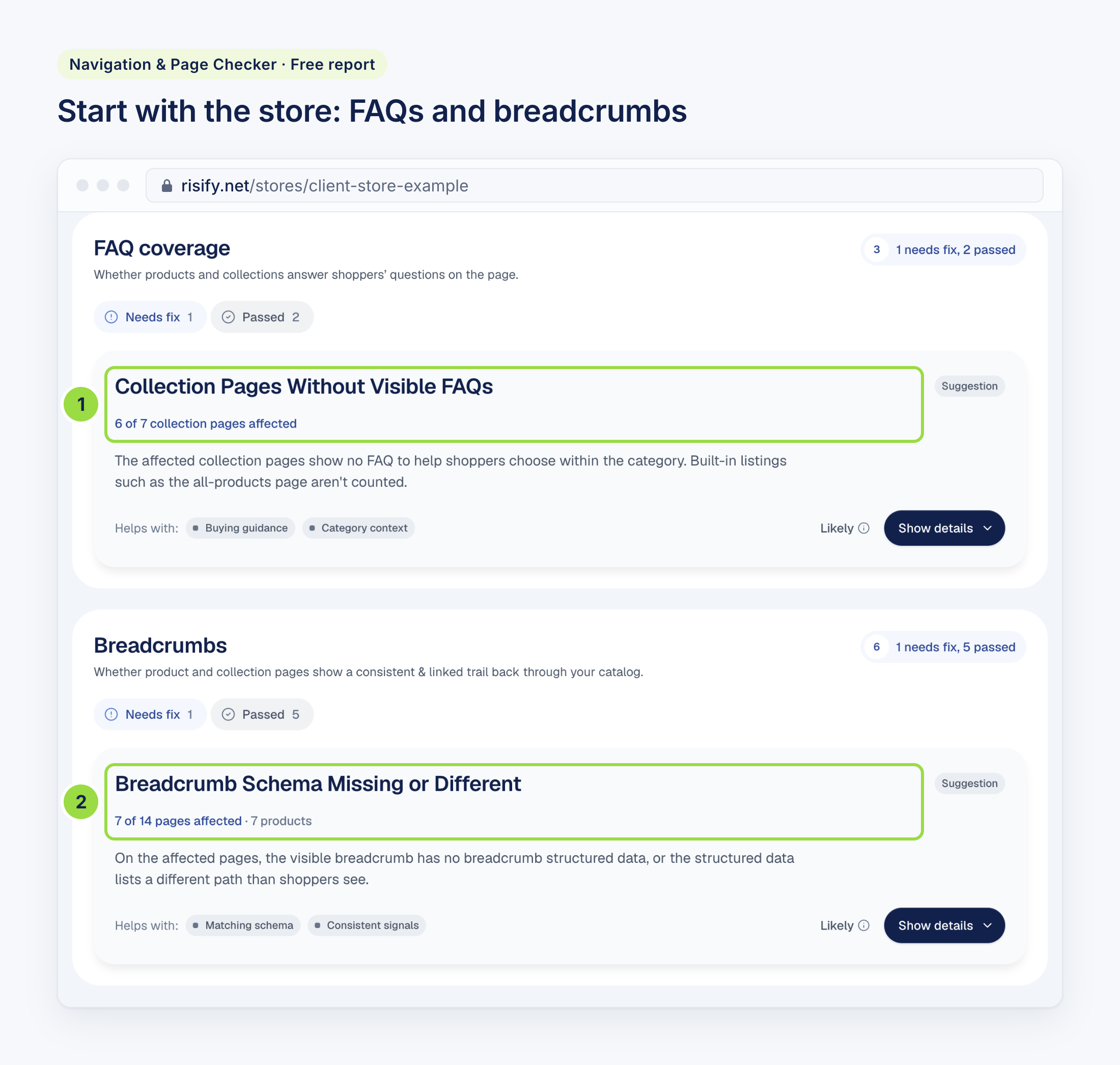
Start with the store, not with more tracking. Work through these checks in order.
- Check your structured data. Make sure product pages have complete Product schema and that there are no errors or duplicates. Our guide on how structured data affects AI visibility lists the schema types that matter.
- Check your FAQ coverage. Look at your top collections and products. Do they answer the questions shoppers ask before buying? If not, add FAQs with FAQ schema.
- Check your content depth. Product descriptions should state specifications. Collection pages should explain what the category is and who it is for.
- Check your structure. Breadcrumbs should show a clear path. Important collections should be linked from the homepage and from related collections. You can use Risify’s free Shopify Navigation & Page Checker
- Look at the sources AI tools cite. If the answers rely on review sites, forums or publications where you are absent, part of the work is getting mentioned there.
The AI search readiness checklist for Shopify covers these checks in detail.
How do tracking and optimization work together?
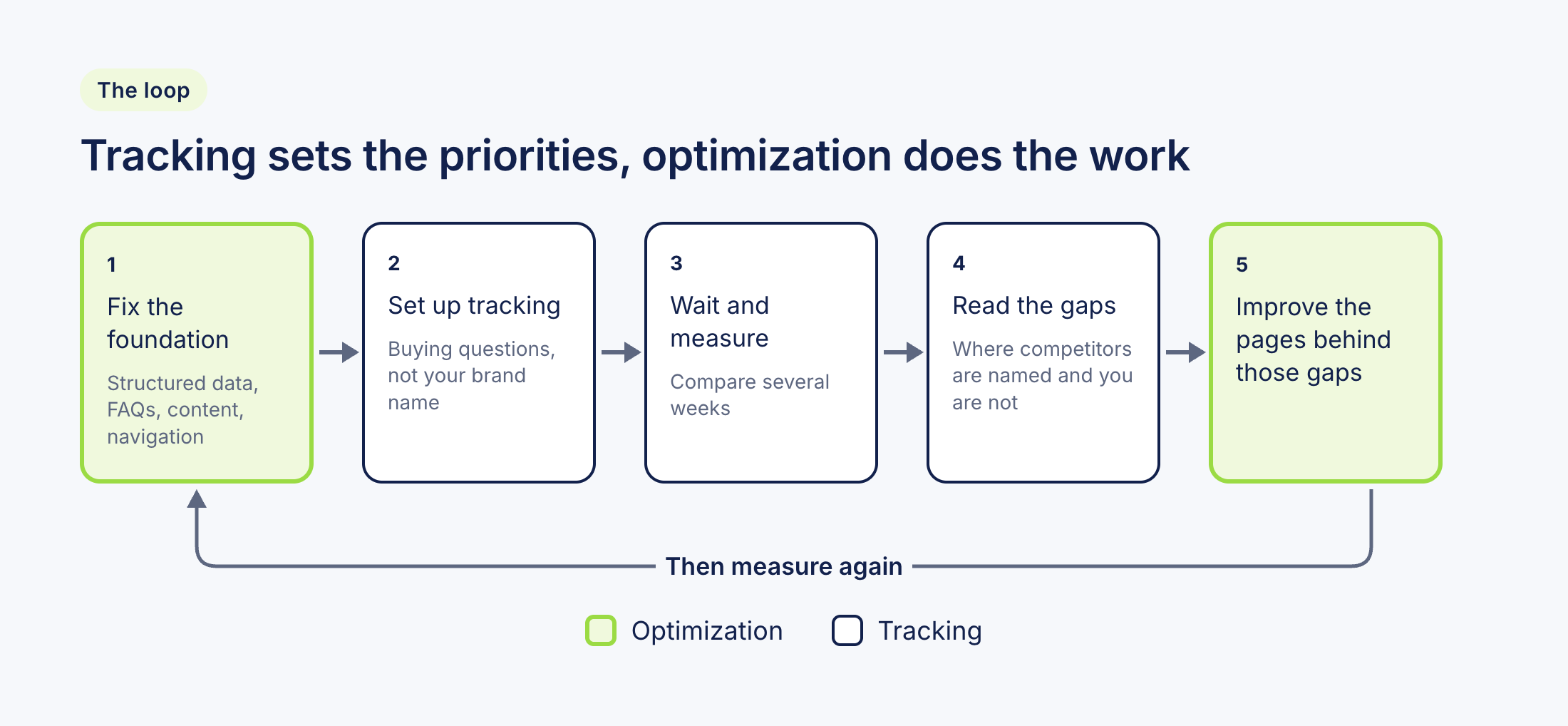
They work as a loop. Each round makes the next one more focused.
- Fix the foundation. Structured data, FAQs, content and navigation for your most important pages.
- Set up tracking. Choose prompts that match how your shoppers ask. Use buying questions, such as “best waterproof hiking boots for wide feet”, and not your brand name alone.
- Wait and measure. AI tools need time to re-read your pages. Compare several weeks, not single days.
- Read the gaps. Find the prompts where competitors are named and you are not. Look at which sources were cited.
- Improve the pages behind those gaps. Then measure again.
In this loop, tracking sets the priorities and optimization does the work.
When does each approach fit?
Tracking only fits a store that already has strong structured data, good FAQ coverage and a clear structure, and now wants a way to monitor results. It also fits a first check, to see whether there is a problem at all.
Optimization only fits a store that knows its foundation is weak and has limited time or budget. Fixing the store is the better use of both.
Both fits any store that treats AI visibility as an ongoing channel, in the same way it treats search.
If you must choose one to start, choose optimization. The work you do for AI tools also improves how search engines read your store, so it pays off even before AI mentions change. We explain the shared foundation in AEO vs GEO vs SEO for Shopify.
Where Risify fits
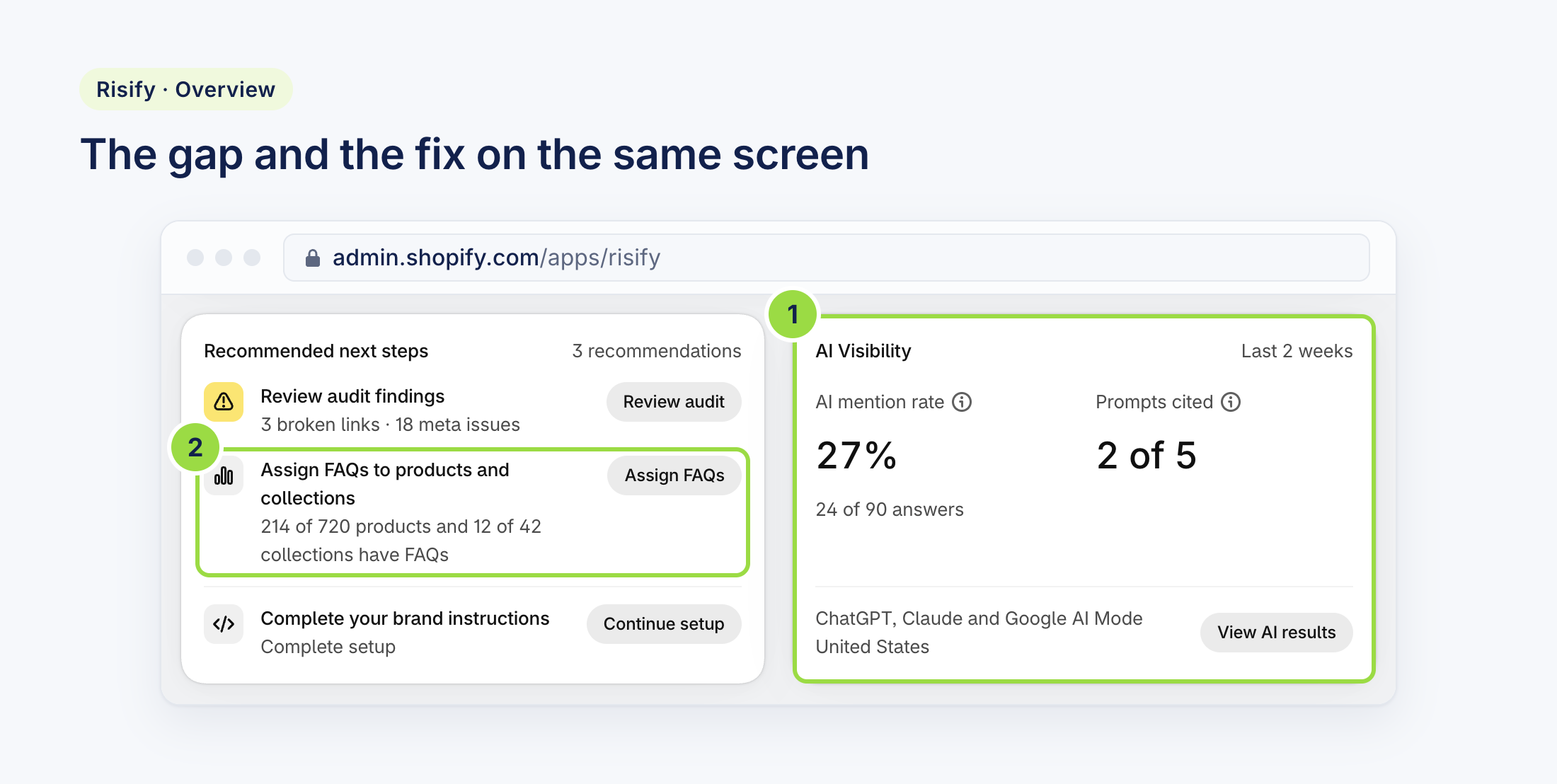
Risify is a Shopify app that optimizes a store’s AI and search visibility by fixing its structure, content and signals, and tracks the result. Optimization is the core of the app. Tracking supports it.
For optimization, Risify includes:
- Structured Data: seven schema types, including Product, Breadcrumb, FAQ and Organization.
- FAQs: reusable FAQs assigned to products and collections.
- Navigation: fixed breadcrumb paths, collection menus and related searches.
- Meta Tags and Page Optimization: bulk editing and page-level improvements.
- Risify AI: content written to your brand instructions.
- AI & Search Audit: more than 100 checkpoints, including schema errors.
For tracking, Risify includes AI Visibility, which runs shopper-style prompts on ChatGPT, Claude and Google AI Mode. It shows how often your store is mentioned, how often your pages are cited as a source, and which sources and competitors appear. Keyword rankings and Search Console data sit in the same section.
Why one app for both matters. When optimization and tracking live in separate tools, someone has to connect the findings to the fixes. In Risify, the prompts you track and the pages you improve are in the same place, so a gap you see in AI Visibility becomes a task in FAQs, Structured Data or Navigation.
You are not left alone with it. Every Risify plan includes expert support and an onboarding call. On Risify Plus, the Risify team sets up schema, integrates your catalog and writes FAQs for your collections and products.
It works at scale. Bad.no, a Norwegian retailer with more than 30,000 products, grew organic sessions by 132% over 8 quarters with Risify’s structure-first approach. The Bad.no case study has the details.
Risify builds the foundation that search engines and AI tools need. It cannot guarantee that an AI tool will recommend your store, and no app can.
Conclusion
Tracking and optimization answer different questions. Tracking shows whether AI tools mention your store. Optimization changes what they can read. Tracking without optimization leaves you with a number you cannot move. Optimization without tracking leaves you working without feedback.
Fix the foundation first, then measure, then use what you learn to decide what to fix next. Risify was built around that loop, with optimization, tracking and expert support in one Shopify app. You can find Risify on the Shopify App Store.