



To manage SEO and AI visibility across multiple Shopify stores, treat the stores as one system with local differences. Keep the foundation the same everywhere: catalog structure, structured data and FAQs. Localize what shoppers read: language, keywords, prices and policies. Then make each store’s market obvious, so search engines and AI tools send every shopper to the right store, and track each store separately.
Most advice on SEO for multiple Shopify stores stops at search engines. This guide also covers what several stores do to AI answers, and shows how one in-house team can run all of it without an agency in every market.
Key takeaways
Every extra store multiplies Shopify’s structure gaps: flat collections, path-based breadcrumbs and theme-dependent structured data.
Standardize the foundation across stores. Localize keywords, content, prices and policies.
Several stores can confuse AI tools. They may recommend the wrong store or quote another market’s prices and terms.
Each store should state its market clearly, on the page and in its structured data.
Track rankings and AI answers per store. A blended number hides the store that is struggling.
Why are search and AI visibility harder with several stores?
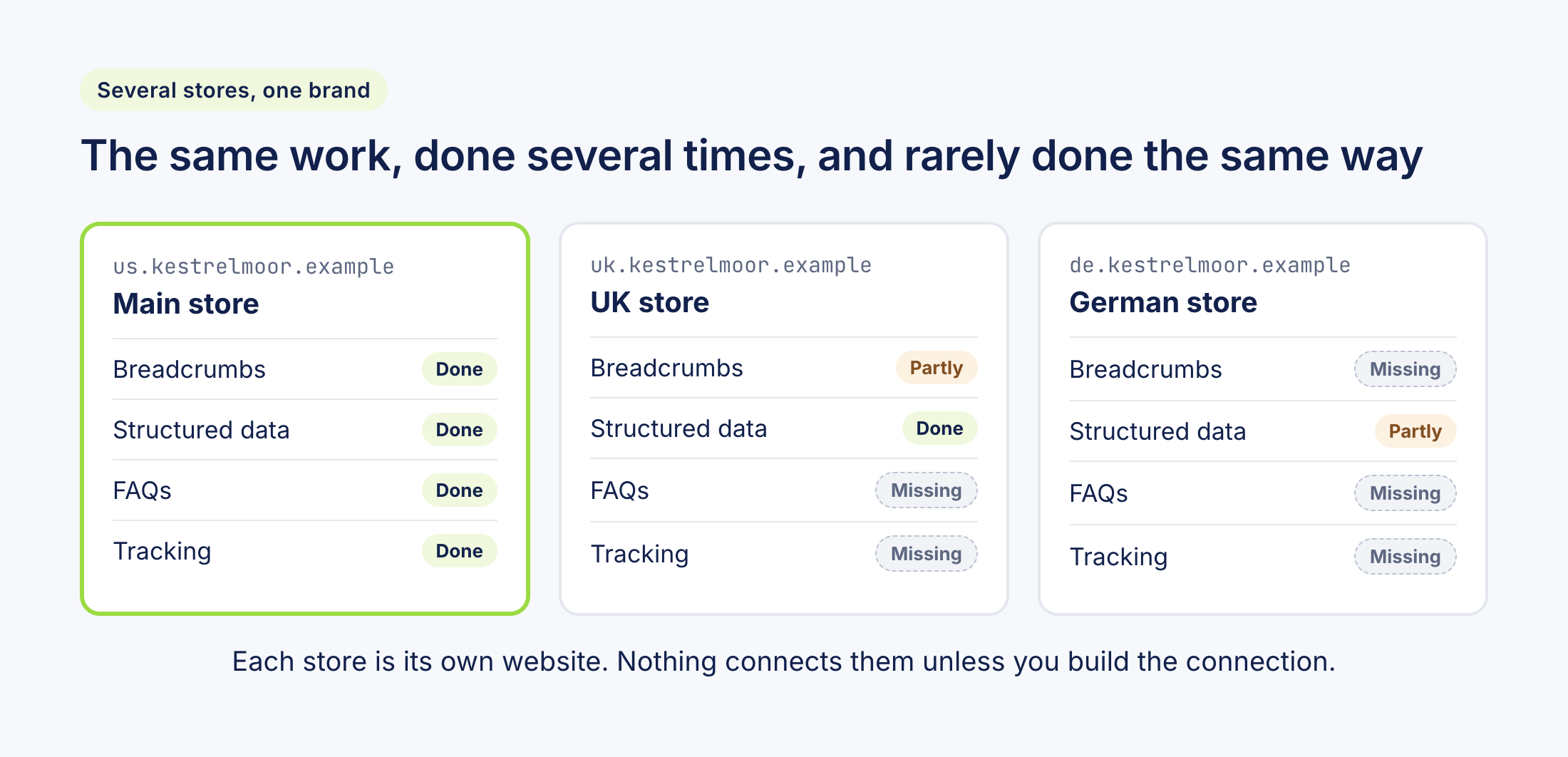
Each Shopify store is its own website to search engines and AI tools, and nothing connects the stores unless you build the connection.
The same work, done several times
Breadcrumbs, structured data, meta tags and FAQs have to be set up in every store. The main store gets done properly and the others partly.
Stores fall out of sync
A collection gets restructured in one store and not the others. After a year, no two stores are organized the same way.
Duplicate content across markets
Stores in the same language, such as a US store and a UK store, often share product descriptions word for word. Search engines and AI tools then have to guess which page belongs to which country, and they can guess wrong.
Local behavior differs
Shoppers in different countries use different words for the same product, even in the same language, and they ask AI tools different questions. A copy of your main store’s keywords and content will miss local demand.
Tracking is blended or missing
Most teams watch the main store’s rankings, and few check AI answers for any other store. A store can lose visibility for months before anyone notices.
Should you use one store with markets or several stores?
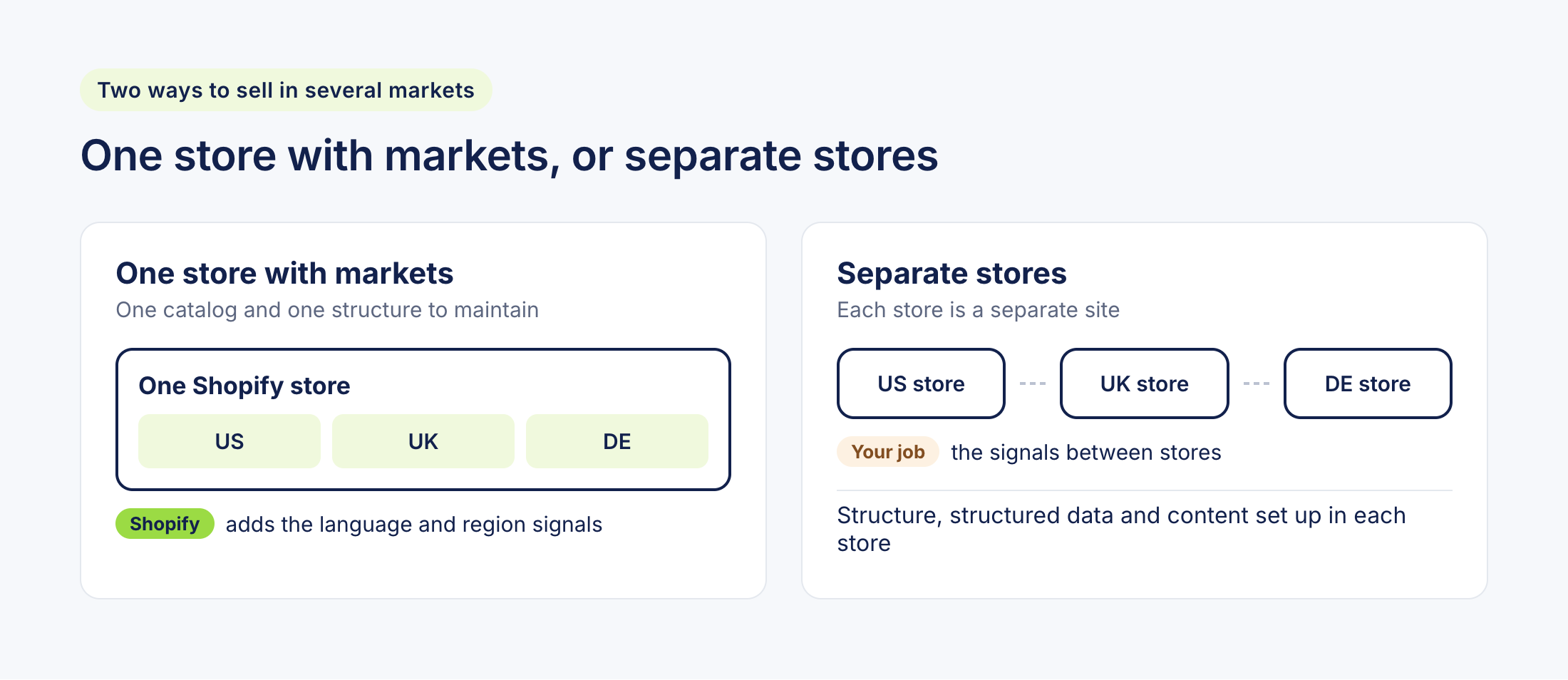
Shopify lets you sell internationally from one store using its markets features. Brands run separate stores when they need different catalogs, pricing or teams. The decision usually rests on operations, but it has consequences:
One store with markets: one catalog and one structure to maintain. Shopify adds the language and region signals between market versions for you.
Separate stores: each store is a separate site. Structure, structured data and content must be set up in each, and the signals between stores are your job.
Either way, the steps below apply, and they matter more with separate stores.
What should be the same in every store?
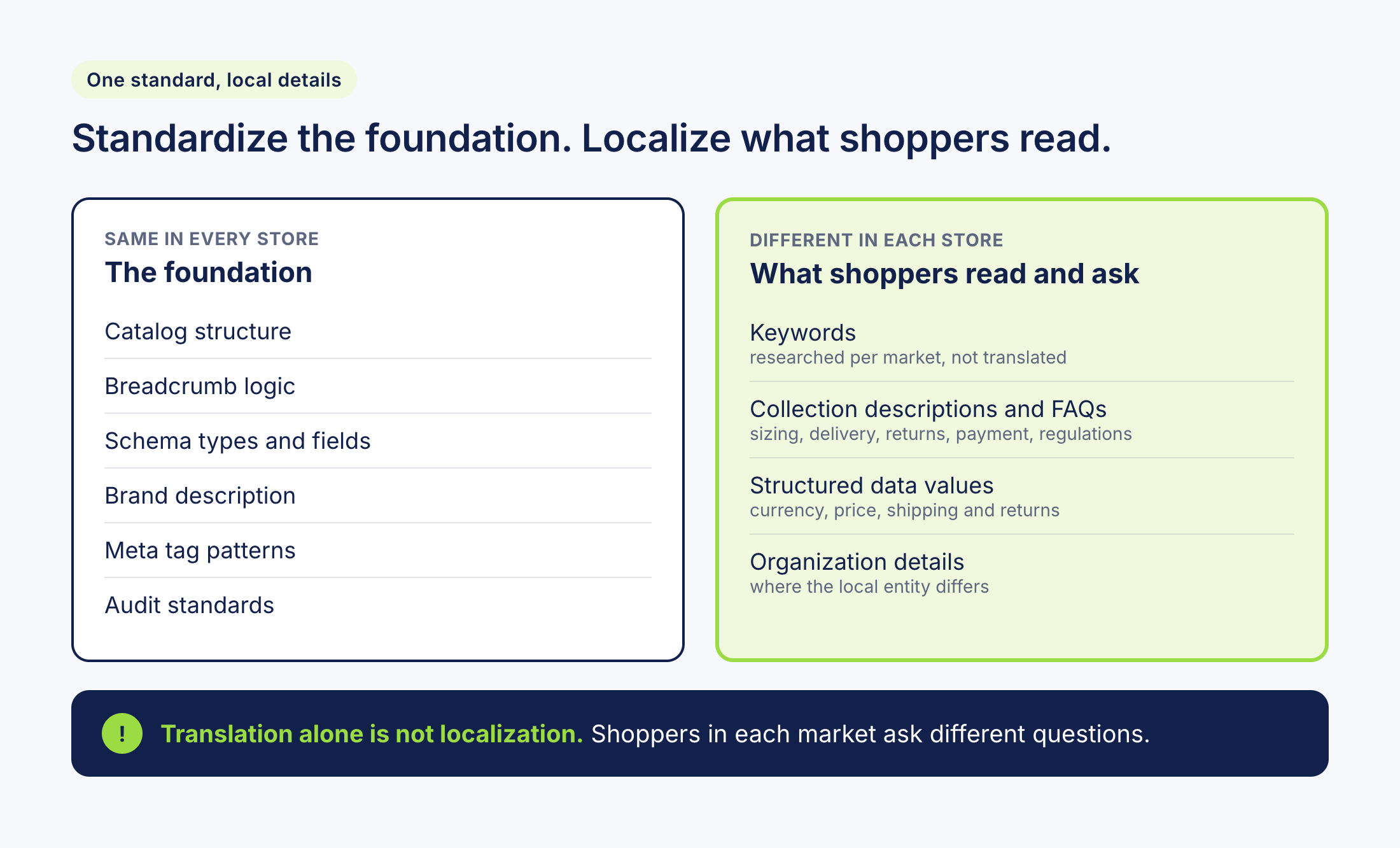
Standardize the foundation. This is the part search engines and AI tools use to understand a store, and it should not vary by market.
Catalog structure. Use the same collection hierarchy in every store, even when collection names are translated.
Breadcrumb logic. Give every product and collection one fixed path that follows the hierarchy.
Structured data. Use the same schema types and fields everywhere: complete Product schema with price, availability, shipping and returns, plus Breadcrumb, FAQ and Organization schema. Our Shopify schema markup guide lists what complete looks like.
Brand description. Describe your brand in the same words in every store, in Organization schema, on the About page and on social profiles. AI tools build their picture of a brand from all of these.
Meta tag patterns. One pattern for titles and descriptions, translated.
Audit standards. Run the same audit on every store and hold each to the same bar.
Write this down as a one-page internal standard.
What should be different in each store?
Localize what shoppers read, search for and ask about.
Keywords. Research each market separately. Do not translate your main store’s keyword list.
Collection descriptions and FAQs. Answer local questions: sizing, delivery times, returns, payment methods, regulations.
Structured data values. Currency, price, shipping and return details must match the local store, in the page’s language.
Organization details, where your local entity or contact details differ.
Translation alone is not localization. A German shopper asks different questions about delivery and returns, and AI tools answering in German look for pages that address them.
How do you stop stores competing in search?
When stores share a language, tell search engines which page serves which market.
Language and region signals. These tags tell search engines “this page is the UK version of that page”. Shopify adds them for markets inside one store. Between separate stores, they have to be added.
Local content. Even small differences help: local spelling, currency, delivery information and FAQs.
What do several stores do to AI answers?
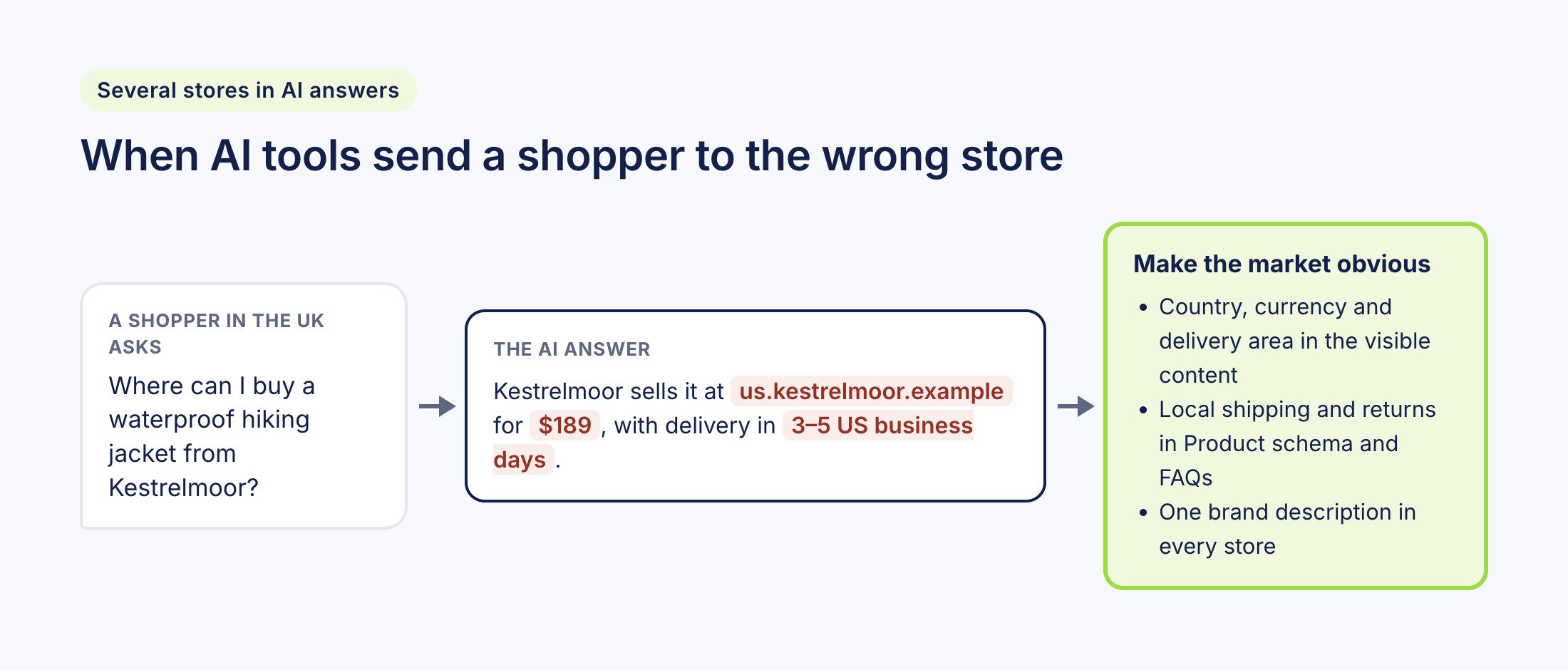
Several stores give AI tools more chances to get your brand wrong. Search engines have established signals for choosing a country version. AI tools may not use them the same way, so your pages have to make the market obvious.
| Problem | What it looks like | Fix |
|---|---|---|
| The wrong store is recommended | A UK shopper asks for a product and gets a link to your US store, priced in dollars | State the market on every page: country, currency and delivery area in the visible content, not only in tags |
| Facts from another market | The answer quotes US delivery times or a return window that differs in the UK | Put local shipping and return details in each store’s Product schema and in on-page FAQs |
| An inconsistent brand | The brand sounds premium in one answer and budget in another, depending on which store was read | Use one brand description and the same Organization details in every store, changing only local contact details |
| One store gets all the citations | AI tools cite your main store even for questions from other markets | Give each store content that answers local questions: FAQs, buying guides, collection descriptions |
Shopify’s Knowledge Base app, which supplies store policies to AI shopping agents, is set up per store, so fill it in with each store’s own policies. How Structured Data Affects AI Visibility explains how AI tools use these signals.
How do you track each store?
Track every domain as its own project, with settings that match its market. Check both halves: where each store ranks in search, and what AI tools say when shoppers in that market ask.
Keyword rankings per domain, measured in that store’s country and language. Rankings in the United States say nothing about your French store.
Search Console per domain, reviewed separately.
AI answers per store. Ask local buying questions and note which of your stores is named, which competitors appear and which sources are cited.
Audit scores per store, compared over time.
Checking AI answers outside the United States
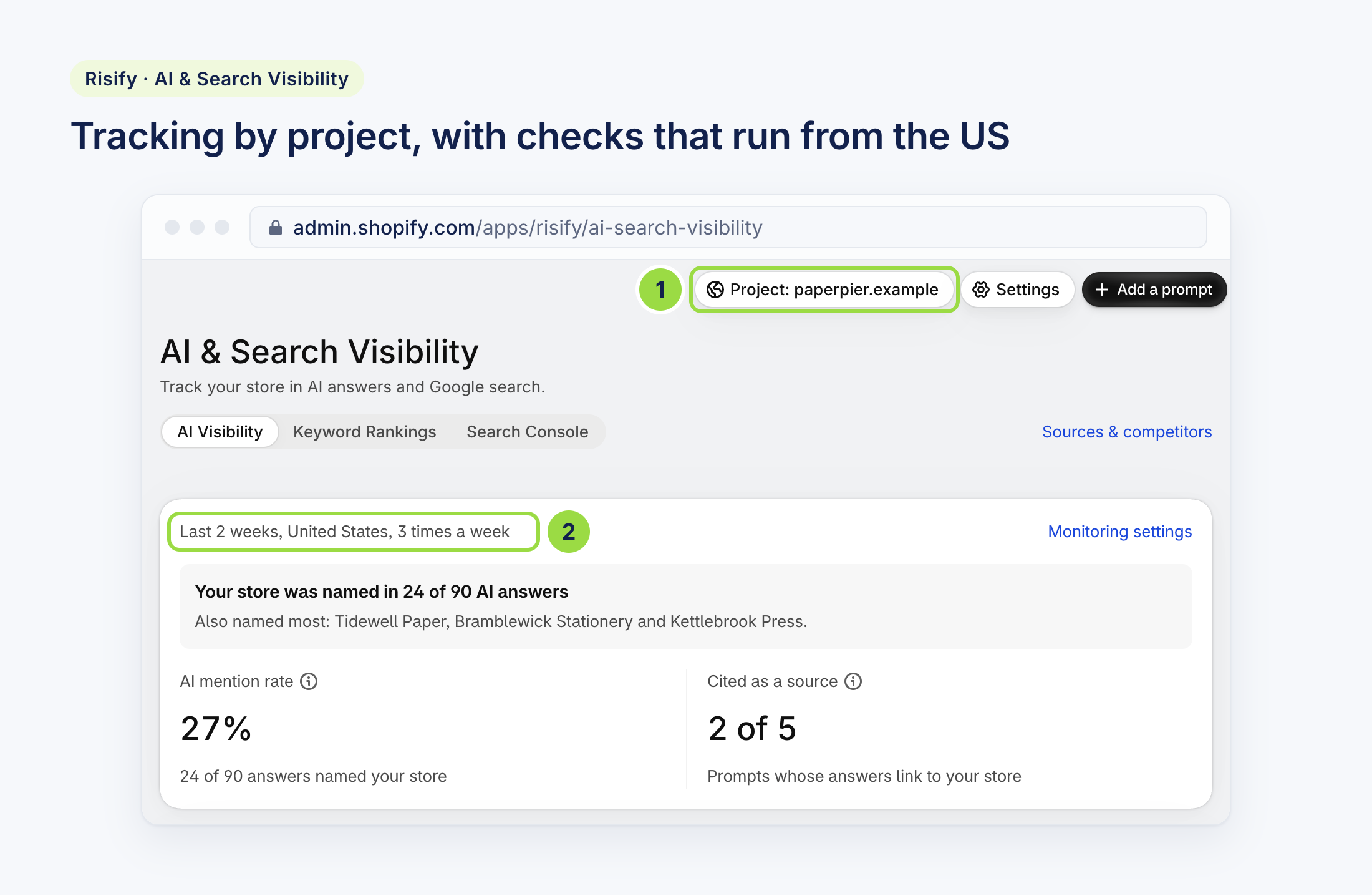
Risify’s AI Visibility checks currently run from the United States, so they show what a US shopper sees. Shoppers elsewhere can get different answers, because AI tools can take language and location into account.
For each other market, add a manual check once a month:
Write five to ten buying questions in the local language, the way a local shopper would ask them.
Ask each one in a new, temporary chat, ideally from someone in that market.
Note which of your stores is named, the currency and delivery terms quoted, the competitors named and the sources cited.
Compare with last month.
Our guide on how to check if AI tools mention your Shopify store covers the method.
Compare the stores once a month and work on the one that lags most. Our guide to Shopify keyword tracking covers what to track.
A working routine for a multi-store team
Name one owner for the standard.
Fix the main store first: structure, structured data and FAQs.
Roll the standard out store by store, largest market first.
Localize keywords, descriptions, prices, policies and FAQs, and make each store’s market obvious.
Audit every store on the same schedule.
Compare stores monthly, in search and in AI answers, and act on the weakest.
A few years ago, this needed an agency in each market, or one large retainer. Most of it can now be done by one in-house team from the Shopify admin, without touching code.
How Risify covers multi-store setups
Risify is a Shopify app that optimizes a store’s AI and search visibility by fixing its structure, content and signals, and tracks the result. It is made by Solverhood, the team behind Analyzify. For a multi-store team, it means the same foundation built the same way in every store, and a view of how each one is doing.
Build the same foundation in every store:
Navigation: fixed breadcrumb paths, collection menus and related searches.
Structured Data: seven schema types, including Product, Breadcrumb, FAQ and Organization. Risify Plus includes multi-language schema.
FAQs: reusable FAQs for products and collections, so local delivery and returns questions are answered on the page.
Meta Tags and Risify AI: bulk editing, and content written to your brand instructions, so every store describes the brand the same way.
AI & Search Audit: more than 100 checkpoints, so every store is held to the same bar.
See how each store is doing:
Keyword Rankings. Tracking is organized into projects, one per store domain, each with its own country, language and device settings. Risify Standard tracks 100 keywords on 1 domain, and Risify Plus tracks 1,000 keywords across 5 domains. Limits are counted across all projects.
AI Visibility. Prompts are tracked per project on ChatGPT, Claude and Google AI Mode. Checks currently run from the United States, so pair them with the manual check above for other markets.
Search Console data sits next to both.
Help for the rollout. Every plan includes expert support and an onboarding call. On Risify Plus, the Risify team sets up schema, integrates your catalog and writes FAQs, taking the heaviest part of the rollout off your team. Multi-store pricing is available on request.
It works at scale. Bad.no, a Norwegian retailer with more than 30,000 products, grew organic sessions by 132% over 8 quarters with Risify’s structure-first approach. Read the Bad.no case study.
Risify builds the foundation search engines and AI tools need. It cannot guarantee rankings or AI recommendations, and no app can.
Multi-store SEO and AI visibility checklist
One written standard covers structure, breadcrumbs, structured data, brand description and meta tag patterns.
Every store follows the same collection hierarchy, with fixed breadcrumb paths.
Structured data is complete in every store, with local currency, shipping and returns.
The brand is described the same way in every store and on external profiles.
Every page makes its market obvious: country, currency and delivery area.
Keywords, descriptions and FAQs are localized, not only translated.
Stores that share a language have signals showing which page serves which market.
Each domain is tracked separately for rankings and Search Console.
AI answers are checked per market, with a manual check outside the United States.
Every store is audited on the same schedule, and someone compares the stores each month.
Our guide on how to fix Shopify SEO and AI visibility gaps explains the foundation items.
Conclusion
Several stores do not need several strategies. They need one foundation applied everywhere, local content and facts where they count, clear signals about which store serves which market, and tracking for each store in search and in AI answers.
One team can now run it. Risify gives that team the same tools and standards in every store, tracking per domain and experts to help with the rollout. You can find Risify on the Shopify App Store.
What Most People Ask
Set one standard for structure, breadcrumbs, structured data and brand description, and apply it to every store. Localize keywords, content, prices and policies. Track each store separately, in search and in AI answers.
Yes, it can happen, especially when stores share a language and similar content. Make each store's market obvious: currency, delivery area, and local shipping and return details, on the page and in structured data.
Create a separate project for each domain, with its own country and language settings, and track rankings, Search Console data, AI answers and audit scores per store.
Risify's AI Visibility checks currently run from the United States. For other markets, run a monthly manual check: ask local buying questions in the local language, ideally from someone in that market, and note which store is named and which terms are quoted.
They can, when stores in the same language share the same text. Add language and region signals between the stores and localize the content, so search engines and AI tools know which page serves which market.
One store is simpler to maintain, and Shopify handles the signals between market versions. Separate stores give more control and need more work.
Yes. Tracking is organized by project, one per domain. Risify Standard covers 1 domain and Risify Plus covers 5 domains, and multi-store pricing is available on request.
Not for the foundation. One in-house team can keep structure, structured data, FAQs and tracking consistent across stores with an app. Local link building and PR may still need local help.