




Shopping queries triggering AI Overviews grew 5.6 times between November 2024 and March 2026, according to SE Ranking’s analysis.
For “best of” product queries specifically, AI Overviews now appear in 83% of cases.
Most merchants haven’t noticed the shift because AI Overviews look like a natural part of the search results page.
But the products that appear inside these summaries are not pulled randomly.
Both Google and Microsoft have publicly confirmed that structured data plays a direct role in helping their AI systems interpret web content accurately. (More details below)
If your store’s pages aren’t structured in a way this system can read, your products may simply not appear when a shopper asks Google for a recommendation.
This post covers:
- How Google AI Overviews select products,
- What data the system relies on,
- What independent research says about the role of structured data,
- How Shopify merchants can improve their chances
Key takeaways:
- AI Overviews now appear on 14% of shopping queries, up 5.6x in just a few months, with product carousels integrated directly into the AI-generated summaries
- Product recommendations in AI Overviews are powered by Google’s Shopping Graph, a database of over 50 billion product listings
- Independent studies found a positive correlation between schema markup and AI citations
- The schema types most relevant to ecommerce stores (Product, FAQPage, BreadcrumbList, Organization) align with the types that performed best across research
What Are Google AI Overviews?
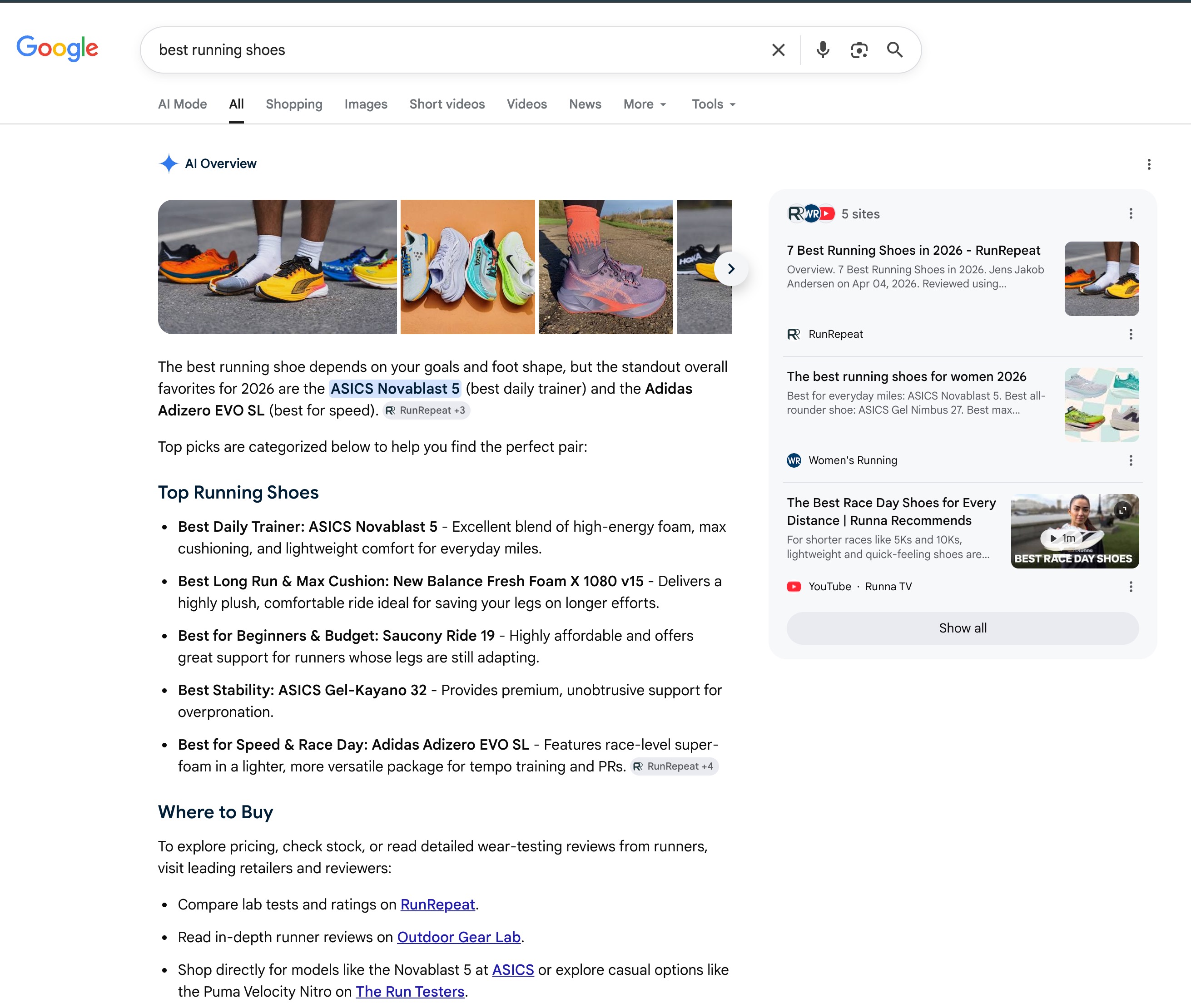
Google AI Overviews are AI-generated summary boxes that appear at the top of Google search results.
Instead of showing a list of links, Google synthesizes an answer from multiple sources and presents it directly in the search results.
For product-related queries, these summaries can include specific product recommendations, feature comparisons, pricing highlights, and buying guidance.
When a shopper searches for something like “best running shoes,” AI Overviews may generate a curated response that includes product carousels with ratings, prices, and direct links to stores.
Since expanding to over 100 countries in late 2024, AI Overviews now reach more than one billion users every month.
It is worth noting that AI Overviews and Google’s newer AI Mode are different experiences. AI Overviews are summary boxes within regular search results.
AI Mode is a separate, fully conversational shopping experience where users ask questions and Google responds with an interactive product discovery flow.
Both draw from the same underlying product data, but they serve different stages of the shopping journey.
For ecommerce stores, both represent the same fundamental shift: Google is increasingly generating product recommendations rather than just listing links to product pages.
How AI Overviews Select Products for Ecommerce Queries
Understanding the selection process matters because it reveals exactly what your store needs to provide.
The Shopping Graph
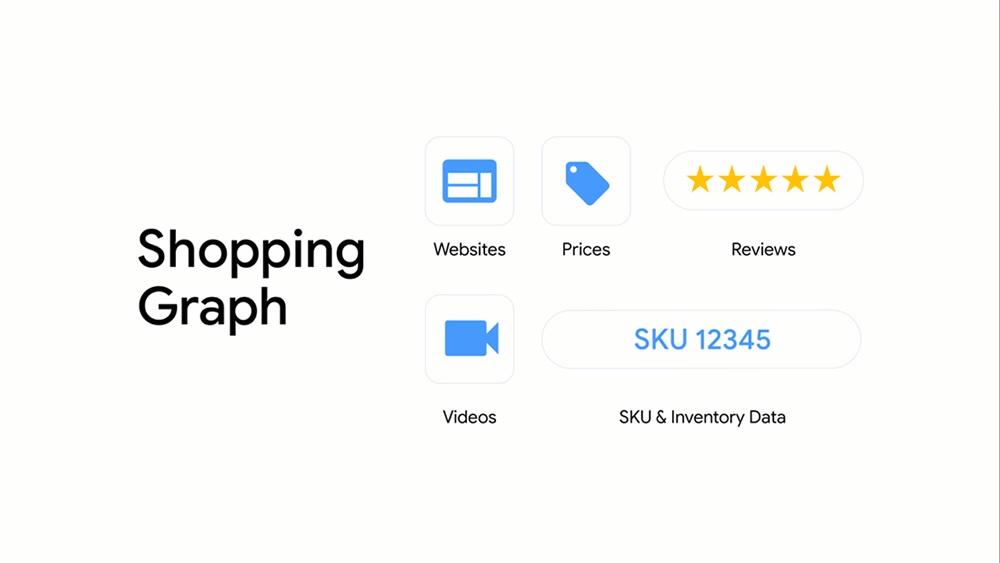
At the center of Google’s product recommendation system is the Shopping Graph: a structured database containing over 50 billion product listings that updates two billion entries every hour.
This graph is fed by two primary sources.
The first is Google Merchant Center, where retailers submit product feeds with structured attributes like titles, GTINs, pricing, availability, and images.
The second is schema markup on product pages, which provides an additional structured data layer that Google’s systems can read directly from your website.
When a shopper asks a product question, Google AI Overviews draws from this graph to generate its response.
The quality and completeness of your data within this graph directly influences whether your products are considered.
What the System Evaluates at Page Level
Beyond the Shopping Graph, Google evaluates individual pages for several signals when deciding what to cite in an AI Overview.
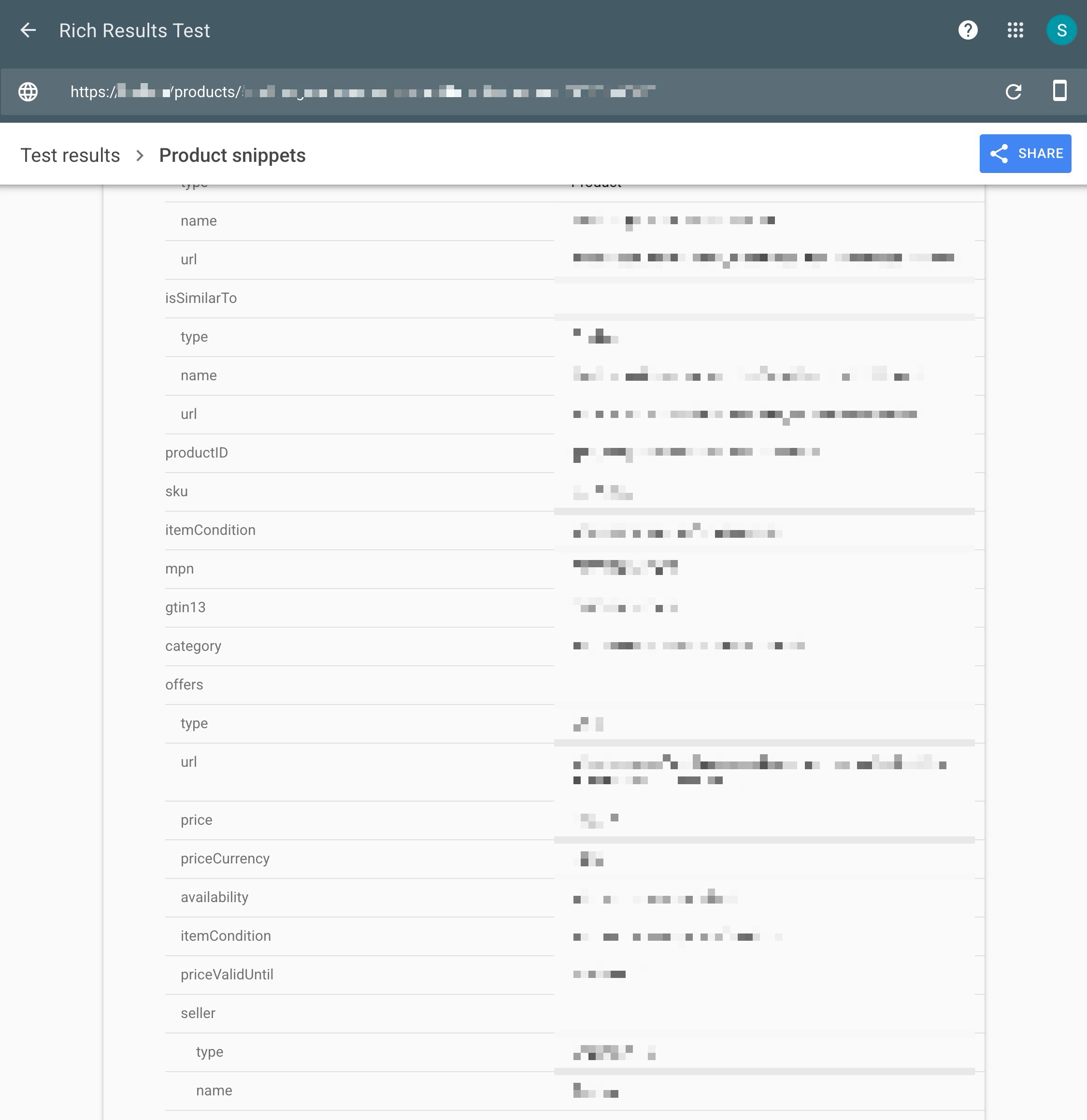
Product attributes matter first: price, availability, brand, identifiers like GTIN or MPN, review data, and image quality.
The system favors pages where this information is explicitly declared rather than buried in unstructured text.
Consider the difference.
A sentence on a product page that reads “Now just $249, limited stock remaining” requires the AI to figure out which number is the price and what “limited stock” means for availability.
A Product schema declaration that states “price”: “$249” and “availability”: “InStock” removes that ambiguity entirely.
Content structure also plays a role. Pages with clear headings, organized sections, and explicit question-and-answer content are easier for AI systems to parse and extract from.
Research from Digital Applied found that AI Overviews typically cite between three and eight sources per query, and the cited pages consistently demonstrate clearer content structure than non-cited pages.
Authority and Trust Signals
Google’s E-E-A-T framework (Experience, Expertise, Authoritativeness, Trustworthiness) applies to AI Overviews as well.
Pages on domains with established authority are more likely to be cited. Internal linking structure matters because it helps Google understand how your pages relate to each other and how deep your coverage of a topic goes.
A store that demonstrates organized, in-depth coverage of a product category sends stronger signals than a store with disconnected, isolated pages.
That said, the relationship between traditional search rankings and AI Overview citations is not one-to-one.
Pages ranking on the first page of Google are more likely to be cited, but multiple studies have found that some lower-ranking pages get cited when they have strong topical relevance and clear content structure.
Does Structured Data Affect AI Overviews for Ecommerce?
This is the question that matters most for store owners. The answer comes from two places: official statements from Google and Microsoft, and independent research conducted over the past year.
What Google and Microsoft Have Said
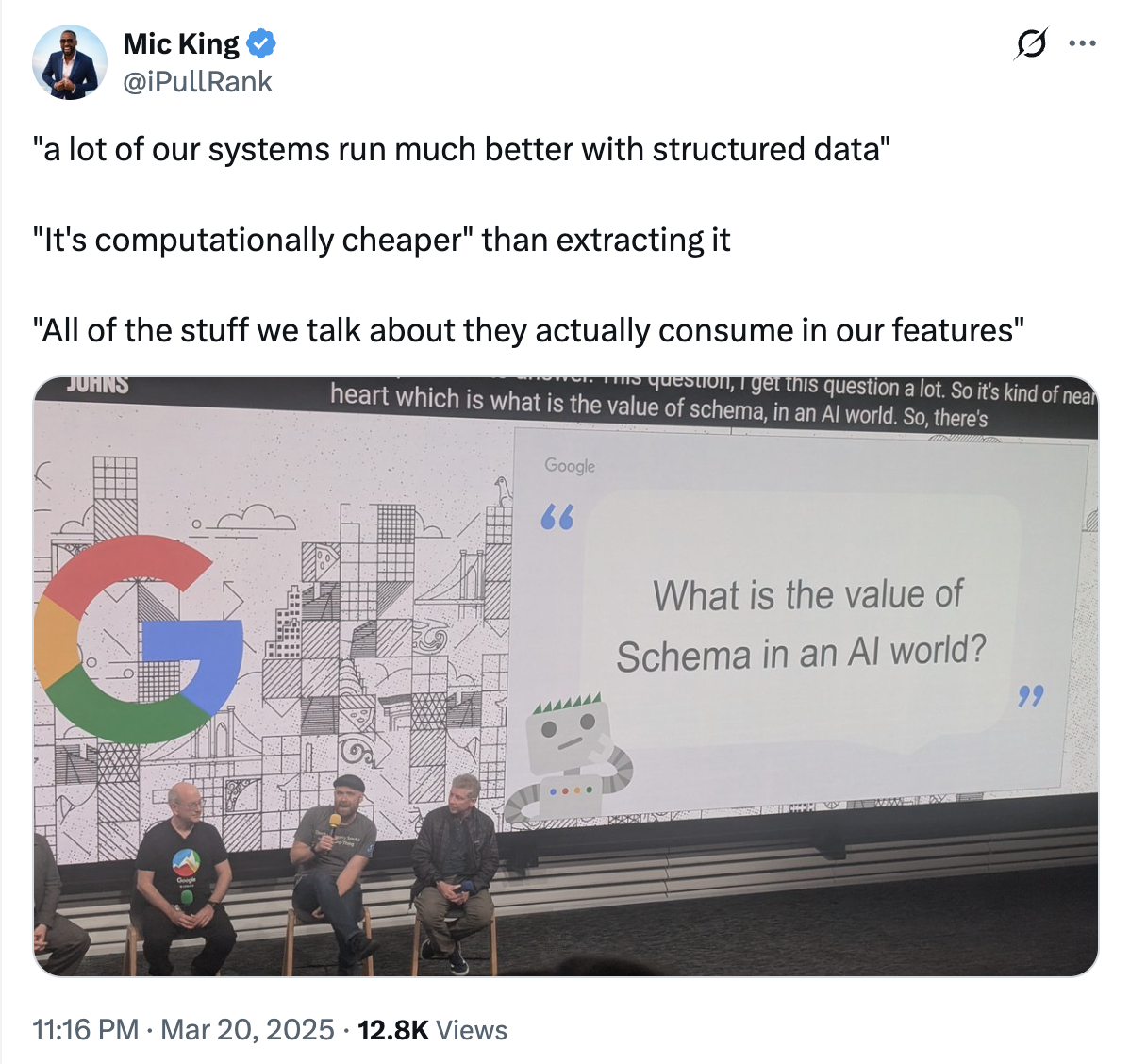
At Search Central Live NYC in early 2025, Google’s Ryan Levering confirmed that structured data makes their systems more efficient by reducing the need to infer meaning from unstructured pages.
Around the same time, Microsoft’s Fabrice Canel stated at SMX Munich that schema markup plays a direct role in helping Microsoft’s LLMs interpret web content.
Neither company said “schema gets you into AI Overviews.”
But both confirmed that structured data improves how accurately their AI systems understand your pages, which is a prerequisite for being recommended.
What Independent Research Found
Over the past year, six independent research teams have tested whether schema markup correlates with AI citations. Five found a positive relationship.
- A controlled experiment published by Search Engine Land tested three identical pages: one with complete schema (Article, FAQ, Breadcrumb), one with broken schema, and one with no schema at all. Only the page with well-implemented schema appeared in an AI Overview.
- AirOps partnered with Kevin Indig to analyze 16,851 queries across ChatGPT’s retrieval pipeline. Pages with JSON-LD had a 38.5% citation rate compared to 32.0% without, with BreadcrumbList (46.2%) and FAQPage (45.6%) as the top-performing schema types.
- Digital Applied analyzed 1,000 AI Overviews and found schema-marked pages were cited 2.3 times more often than unstructured equivalents. The researchers called schema “the single biggest page-level lever in the dataset.”
- A UC Berkeley research paper introducing the GEO-16 framework found structured data showed a +39% lift in citation probability across Brave, Google AI Overviews, and Perplexity. As an academic study with no commercial interest, this carries particular credibility.
- OtterlyAI presented results at BrightonSEO showing a 1,500% increase in Google AI Overview citations after a sitewide schema rollout across 2,000+ URLs. Notably, the effect was not uniform: citations dropped on ChatGPT, Gemini, and Copilot, while Perplexity showed no change. This highlights that Google’s ecosystem responds most strongly to schema.
- The one study that found no effect was Ahrefs’ analysis of 1,885 pages tracked over seven months. Adding schema produced no measurable uplift in citations on any platform.
But Ahrefs themselves flagged an important caveat: every page in their dataset already had 100+ AI Overview citations before schema was added. These were pages already inside the AI consideration set.
Their conclusion: “If a page is already getting picked up, our data suggests that adding schema isn’t going to push it higher. But for pages that aren’t being seen by AI systems at all, schema markup might still play a role in helping them get crawled, parsed, or indexed in the first place.”
That distinction matters. For most Shopify stores, the challenge is not improving citations on pages AI already knows about. It is getting discovered and accurately interpreted in the first place.
What This Means for Shopify Stores
The practical implications depend on where your store currently stands.
Default Shopify Gaps
Most Shopify themes include basic Product schema (name, price, description) but leave significant gaps.
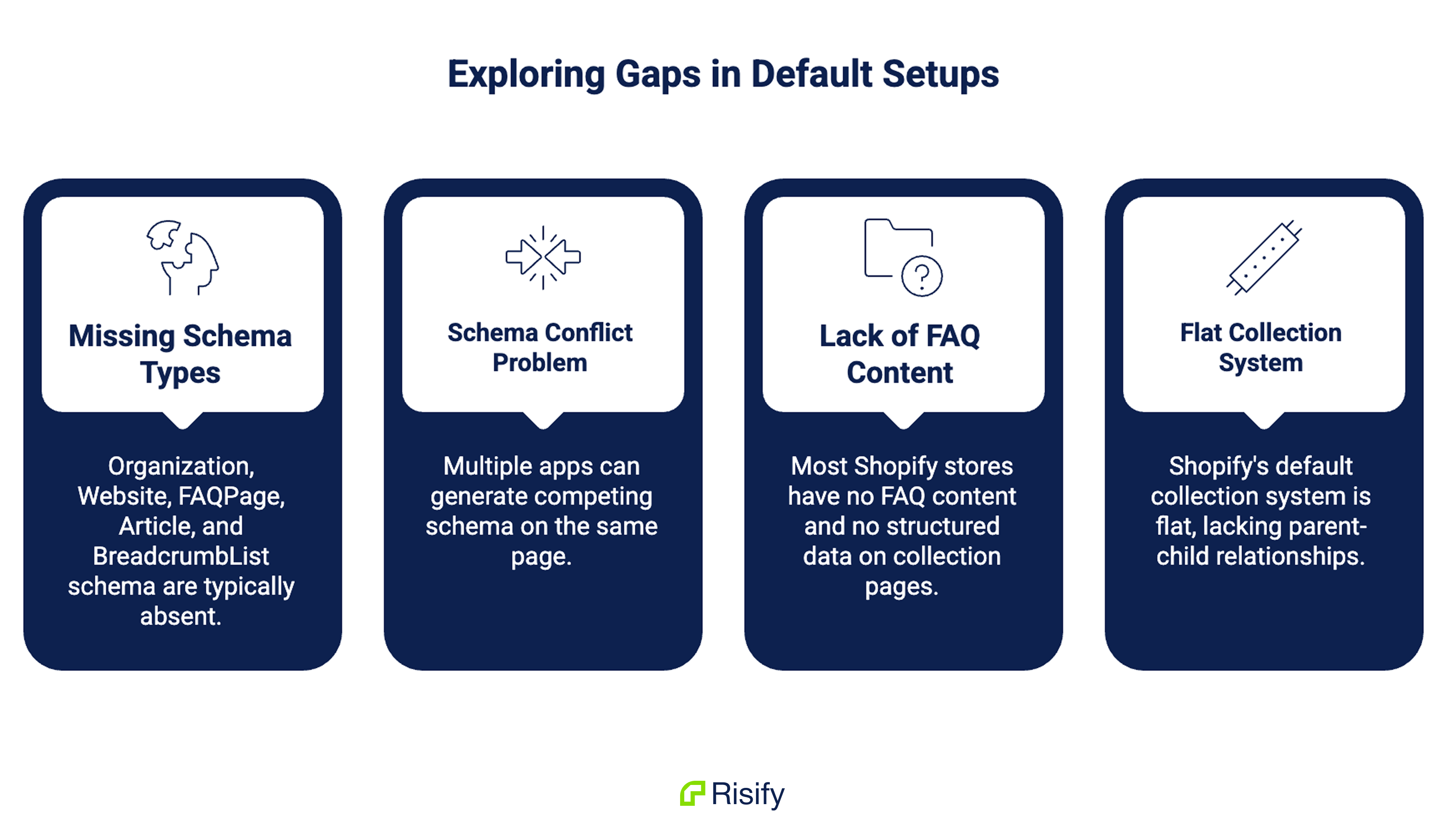
Organization, Website, FAQPage, Article, and complete BreadcrumbList schema are typically absent from default setups. These are exactly the schema types that research shows perform best for AI citations.
There is also a conflict problem. Shopify stores running multiple apps (a review app, an SEO app, and the theme itself) can generate competing schema on the same page.
When Google finds two Product schema blocks with different values, it discards both. Conflicting schema is often worse than no schema at all.
The Collection Page Opportunity
AI Overviews for shopping queries frequently address category-level questions: “best standing desks for home offices,” “memory foam vs spring mattress,” or “what to look for in a wireless router.”
These queries land on collection pages, not product pages. But most Shopify stores have no FAQ content and no structured data on collection pages at all. The store ranked for the query, the shopper arrived, and the page had nothing structured for Google to extract.
This is a significant missed opportunity. Adding FAQ content with proper FAQPage schema to collection pages gives Google explicitly labeled question-and-answer pairs that it can match directly to the types of queries that trigger AI Overviews.
Breadcrumbs and Catalog Hierarchy
AI Overviews don’t just recommend individual products. They often present products within a category context (“here are options in the mid-range standing desk category”).
For that to work, Google needs to understand your catalog hierarchy.
Shopify’s default collection system is flat. There is no native parent-child relationship between collections.
Without proper BreadcrumbList schema communicating that hierarchy, Google has to infer how your categories connect rather than reading it explicitly.
How to Improve Your Store’s Chances of Appearing in AI Overviews
Based on the research and the mechanics of how AI Overviews work, here is a practical sequence for Shopify merchants.
- Start with an audit: Use Google’s Rich Results Test on your highest-traffic product and collection pages. Check whether Product, BreadcrumbList, and FAQPage schema are present and valid. Use Risify’s free Schema Checker for a store-wide view that surfaces gaps across all schema types.
- Prioritize the schema types that matter: Product schema first, then BreadcrumbList, FAQPage, and Organization. These are the types that both the research and Google’s own systems rely on most heavily. Ensure Product schema includes availability, brand, and at least one identifier (GTIN, MPN, or SKU).
- Add structured FAQ content to collection pages: Category-level questions belong on the pages that rank for category-level queries. Write three to six genuine questions per collection, mark them up with FAQPage schema, and ensure the schema text matches the visible page content exactly.
- Define your breadcrumb hierarchy: Each product and collection should have a consistent breadcrumb path that communicates your catalog structure through valid BreadcrumbList schema, regardless of how visitors arrive at the page.
- Keep schema accurate: A price in your markup that does not match the displayed price, or an availability status that is outdated, causes Google to discard the markup entirely. Accuracy matters as much as presence.
For stores that want to skip manual implementation, Risify handles the foundational structure of your Shopify store for organic growth and AI visibility from a single app inside Shopify Admin.
Get all technical foundations set up for better AI search visibility
Risify improves product discovery with clear navigation, centralized FAQs, and smart suggestions, making your store easier for AI tools like ChatGPT and Gemini to understand.

- Navigation and internal linking
- Reusable FAQs and structured content
- Valid schema markup for AI and search visibility
- AI-powered FAQ and metadata generation
- Store audits to see exactly what to fix
Conclusion
AI Overviews now appear on the majority of “best of” product queries and reach over a billion users monthly.
The products featured in these summaries are pulled from Google’s Shopping Graph and both Google and Microsoft have confirmed that structured data helps their AI systems interpret pages accurately.
The opportunity is straightforward: audit your structured data, close the gaps, and make sure your store gives AI systems what they need to recommend your products.